
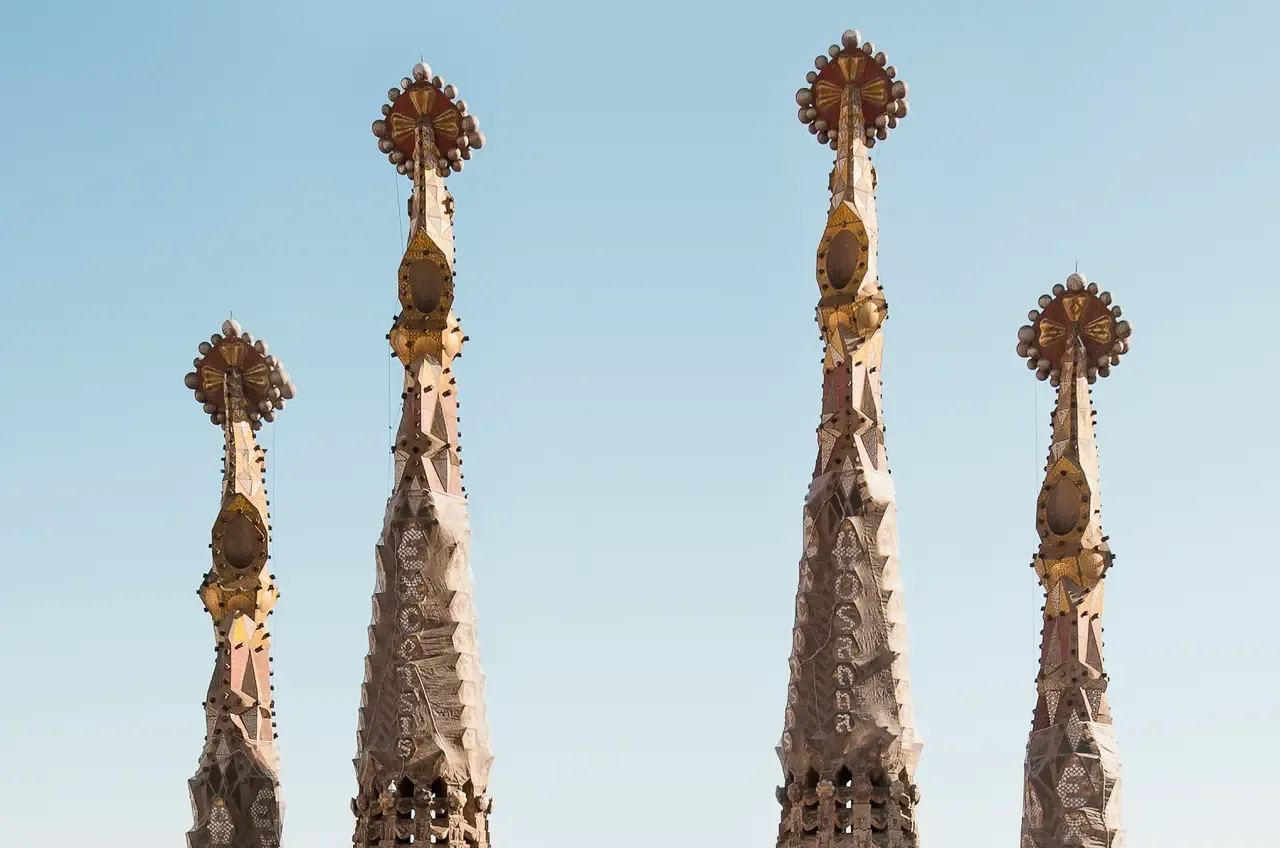
Which tower of the Sagrada Familia is the best?
The Sagrada Familia features a total of 18 towers, though visitor access is limited to those on the facades. For most first-time visitors, the Nativity Tower is the better pick. Sitting on the east facade and designed directly by Antoni Gaudí, it catches warm morning light across carvings that took decades to complete. The Passion Tower works better for visitors seeking shorter queues and direct sea views. Both towers are covered below.
Support when you need it
Customer support to assist you with everything you need from 8:00 AM to 7:00 PM.
Fast and online booking
Choose the ticket that fits your needs and preferences, and skip the lines by booking here.
Top attraction in Barcelona
Explore the city's most iconic basilica and delve into decades of architectural history.
Total number of towers
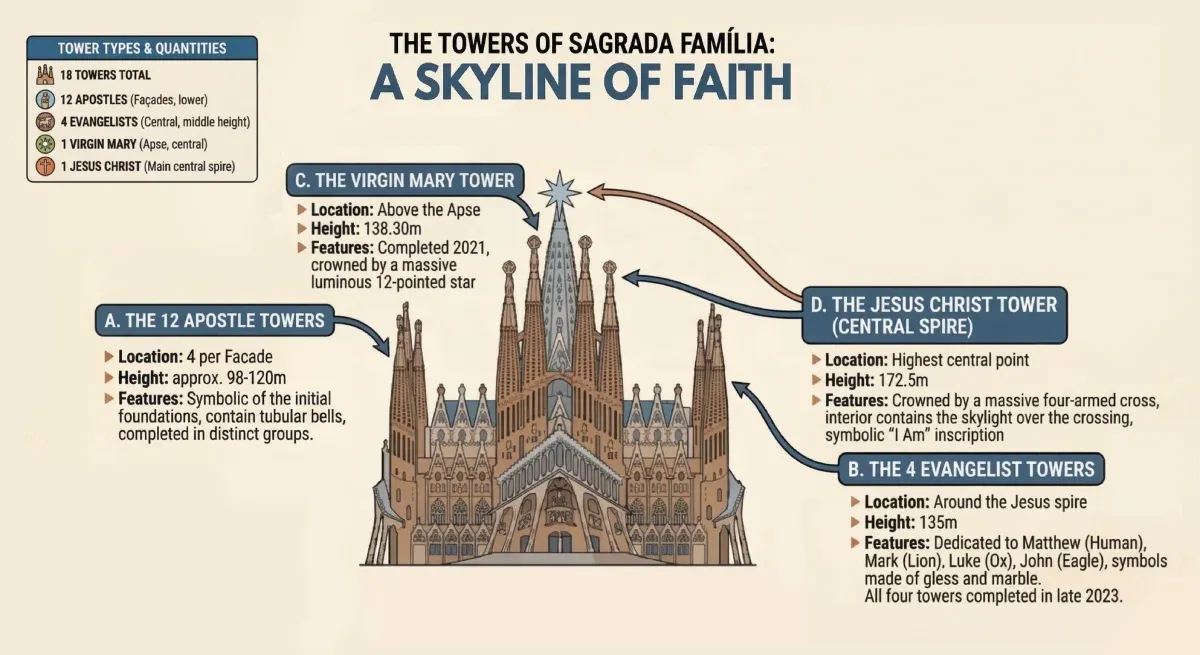
The Basilica of La Sagrada Família consists of 18 towers. The current construction status for these structures is as follows:
- 12 Towers of the Apostles: These towers stand on the three facades. Four towers rise above the Nativity facade, four above the Passion facade, and 4 above the Glory facade. Heights range between 98 and 120 meters. These 12 towers are complete.
- 4 Towers of the Evangelists: These towers surround the central spire. They represent Matthew, Mark, Luke, and John. Each reaches a height of 135 meters. These four towers are complete.
- 1 Tower of the Virgin Mary: This tower stands over the apse. It measures 138.3 meters in height and supports a 12-pointed star. This tower is complete.
- 1 Tower of Jesus Christ: This central spire serves as the highest point of the monument. It reaches 172.5 meters. This tower remains under construction during the 2026 centennial year of Antoni Gaudí's death.
Visitors may access the towers of the Nativity and Passion facades via elevators to view the city and the architectural details of the upper sections. However, the central towers, including those of the Evangelists, the Virgin Mary, and Jesus Christ, remain inaccessible to the general public due to structural and safety regulations.
Which Sagrada Familia tower is better?
Most first-time visitors to Basílica de la Sagrada Família get more from the Nativity Tower. Antoni Gaudí, the Catalan architect, designed it on the east facade, and morning visits catch the best light across its dense stone carvings. Visitors after shorter lift queues and views toward the Barcelona seafront tend to prefer the Passion Tower on the west facade.
Built to Gaudí's original vision, the Nativity Tower has organic stone forms with dense biblical narrative carved into every surface and an aerial view down onto the basilica's most ornate section. After Gaudí's death, Josep Maria Subirachs completed the Passion Tower in a stark, geometric modernist style that shares nothing with Gaudí's approach.
At popular hours, the Nativity Tower draws longer queues; the Passion Tower is usually accessible sooner. Tower access requires a specific ticket type. Visitors who decide on an entry ticket with tower access choose which tower at booking, with availability for both Nativity and Passion Tower time slots.
How do the Nativity Tower and Passion Tower compare?
Four things separate the two towers: architect, design period, facade, and what visitors find at the top:
| Attribute | Nativity Tower | Passion Tower |
|---|---|---|
| Architect | Antoni Gaudí | Josep Maria Subirachs |
| Design style | Organic Catalan Modernisme, dense narrative carvings | Angular geometric modernist, stark figurative sculptures |
| Facade | Nativity Facade | Passion Facade |
| Orientation | East-facing | West-facing |
| Best lighting | Morning: 9:00–11:00 | Afternoon: 15:00–18:00 |
| Queue tendency | Longer at peak hours | Generally shorter |
| Staircase | Narrow spiral descent (~400 steps) | Narrow spiral descent |
| Theological narrative | Birth of Christ | Death and Passion of Christ |
What do visitors see from the Nativity Tower?
The Nativity Tower faces east, which means sunlight hits the facade directly in the morning hours. Visitors who arrive between 9:00 and 11:00 see the carved stone surfaces lit from the front, lighting the carved biblical scenes and organic sculptural forms across the elevated walkway between the towers. By midday the east-facing stone falls into shade, and the surface detail flattens.
From the top of the Nativity Tower, the view extends across the Eixample district toward the hills of Tibidabo and the Collserola mountain range beyond the city. On clear days, the Mediterranean is visible in the distance over the rooftops of the city grid. The tower height gives enough elevation to understand Barcelona's urban geometry in a way that ground-level views cannot provide.
From the bridge walkway between the Nativity Tower's spires, visitors look directly down onto the Nativity Facade carvings. This aerial vantage on Gaudí's most detailed work is one of the few perspectives that lets the full narrative structure of the facade become legible, with the three portals (Faith, Hope, and Charity) visible from above. From the tower bridge, the nave is also visible looking down into the open construction space, revealing the interior of the basilica from above, which covers the stained glass windows and column forest in full.
The Towers of the Twelve Apostles surrounding the Nativity Tower are visible from the walkway at close range. The proximity gives visitors a concrete sense of the basilica's intended scale. Construction of the central tower of Jesus Christ rising above the crossing adds a further vertical reference point visible from the walkway.
What do visitors see from the Passion Tower?
West-facing, the Passion Tower puts the Barcelona seafront and port in the main sightline. Between 15:00 and 18:00, afternoon sun hits the angular Subirachs stonework of the Passion Facade directly below the walkway. That same light catches Montjuic beyond the rooftops, and on clear afternoons the Mediterranean horizon stretches past the port district. The panoramic axis runs toward the sea.
Barceloneta beach and the curve of the coastline are fully visible from the Passion Tower walkway without obstruction. Montjuic, with its hilltop fortification on the summit, anchors the port-side view. Standing on this walkway, Barcelona reads as a coastal city backed by the sea. From the Nativity Tower, the same city reads as an inland metropolis backed by a mountain range. The two towers produce different pictures.
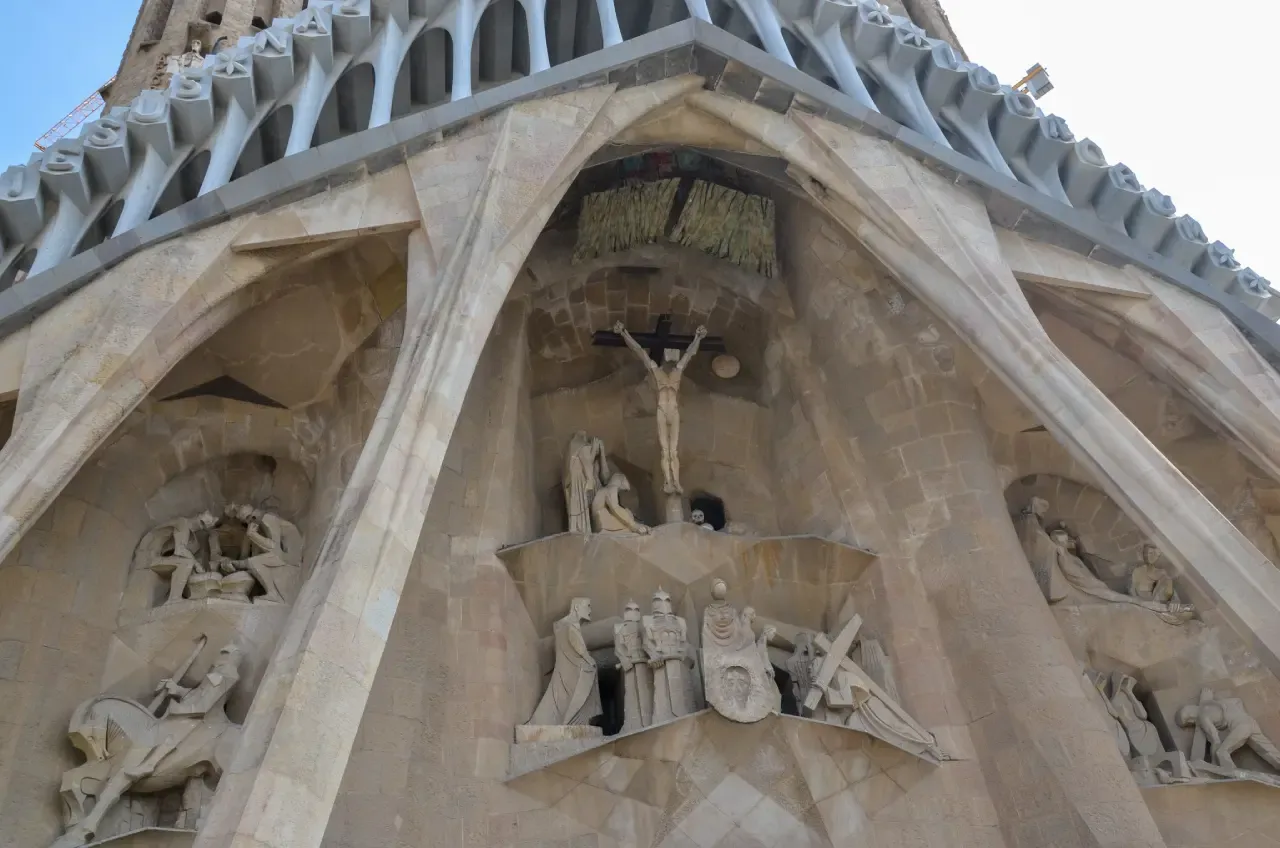
Down below, the Passion Facade is close enough to read its details. Subirachs carved scenes from the Passion of Christ, with the Kiss of Judas prominent at the central section. At street level, the angular stonework looks austere. From above, the geometric composition and its theatrical arrangement of figures become apparent in a way ground-level visitors miss.
When is the best time to visit each tower?
Facade orientation drives the timing. The Nativity Tower faces east; the Passion Tower faces west. Each gets direct light at opposite ends of the day.
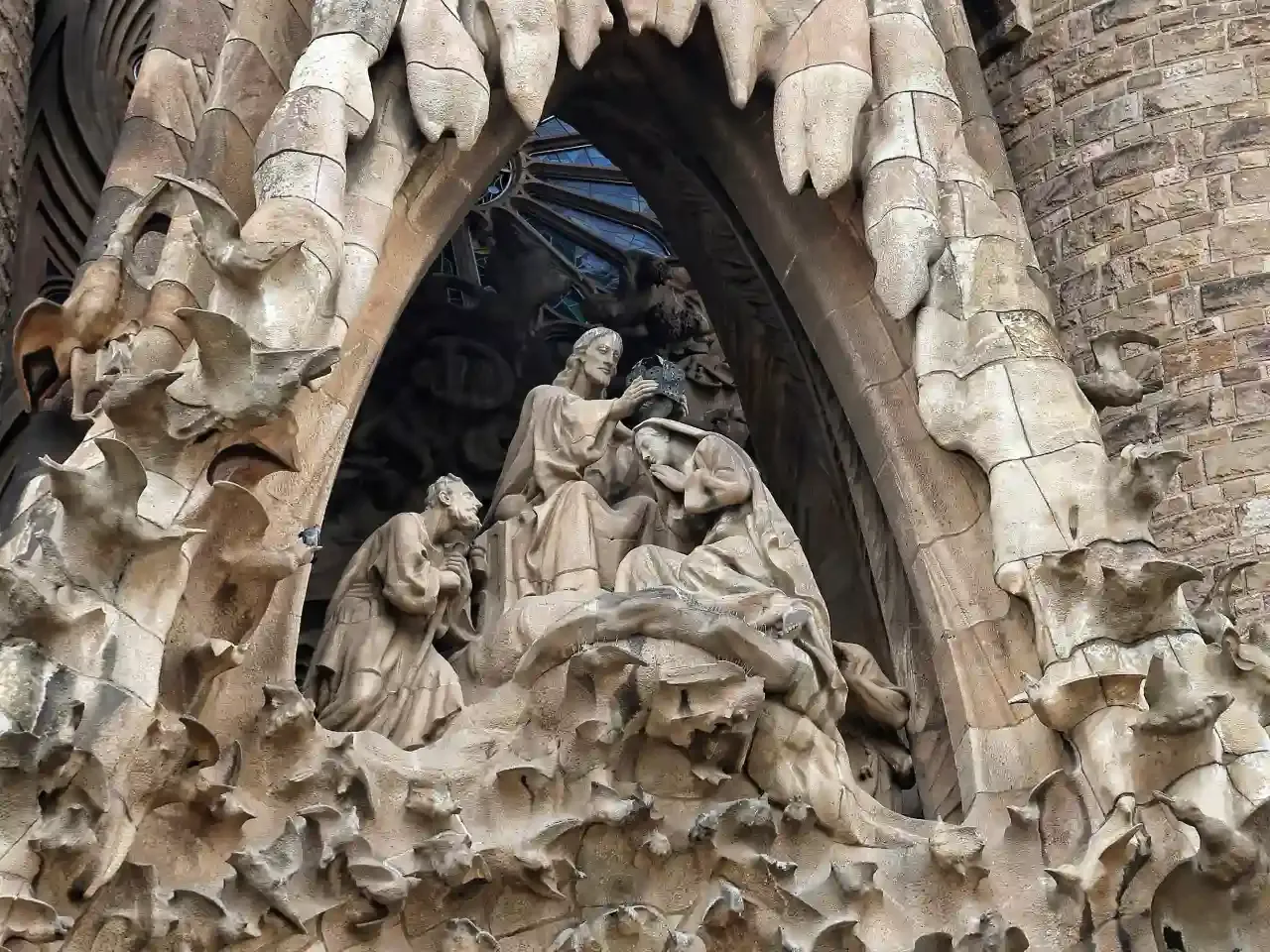
Nativity Tower
Sunlight hits the east-facing Nativity Tower carvings from the front between 9:00 and 11:00. At that hour the surface detail Gaudí spent decades refining is fully legible. Shade crosses the lower sections by midday and the stone loses definition at a distance. Opening-time arrivals get both good light and shorter lift queues before the midday crowd.
What should visitors know about accessibility and the stairs?
- Vertical circulation system: Both towers utilize a lift for the ascent and a staircase for the descent; no return lift service exists.
- Staircase specifications: The Nativity Tower features approximately 400 steps in a tight spiral, requiring most visitors between 15 and 20 minutes to descend at a steady pace.
- Space and movement constraints: The staircase shafts are narrow, preventing two people from passing comfortably at several points.
- Mobility and health considerations: Visitors with knee, hip, or mobility limitations may find the descent difficult. The spiral shafts include small window openings but lack wide rest areas, which may affect those prone to vertigo.
- Age and safety regulations: Children under 6 years of age are strictly prohibited from the towers, and minors under 16 must be accompanied by an adult.
- Footwear recommendations: Closed-toe shoes with sufficient grip are the practical choice for navigating the stone steps.
- Accessibility restrictions: Wheelchair users cannot access either tower due to the structural nature of the staircases.
- Physical demand comparison: Both the Nativity and Passion towers present comparable physical demands, and visitors with elderly companions or young children should factor the long descent into their planning.