
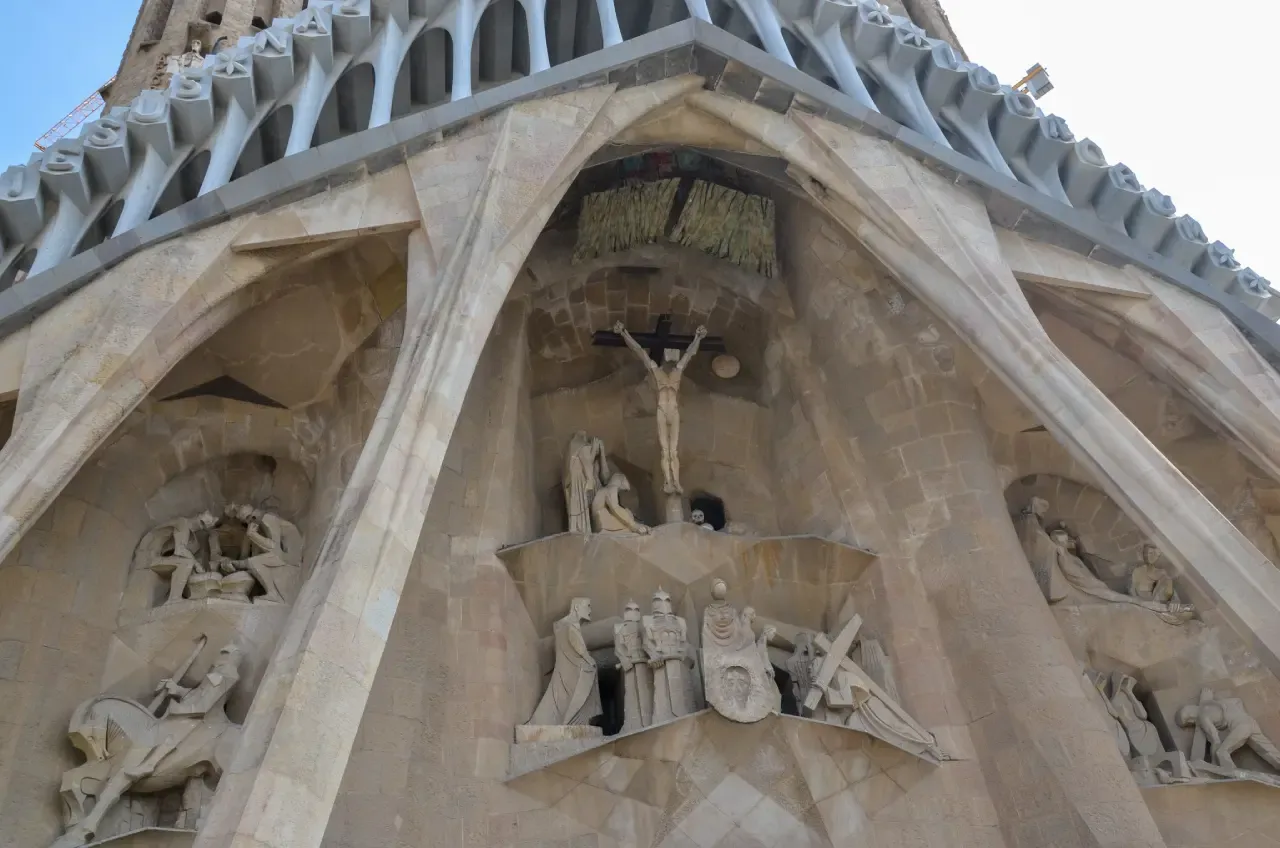
Passion Facade of the Sagrada Familia
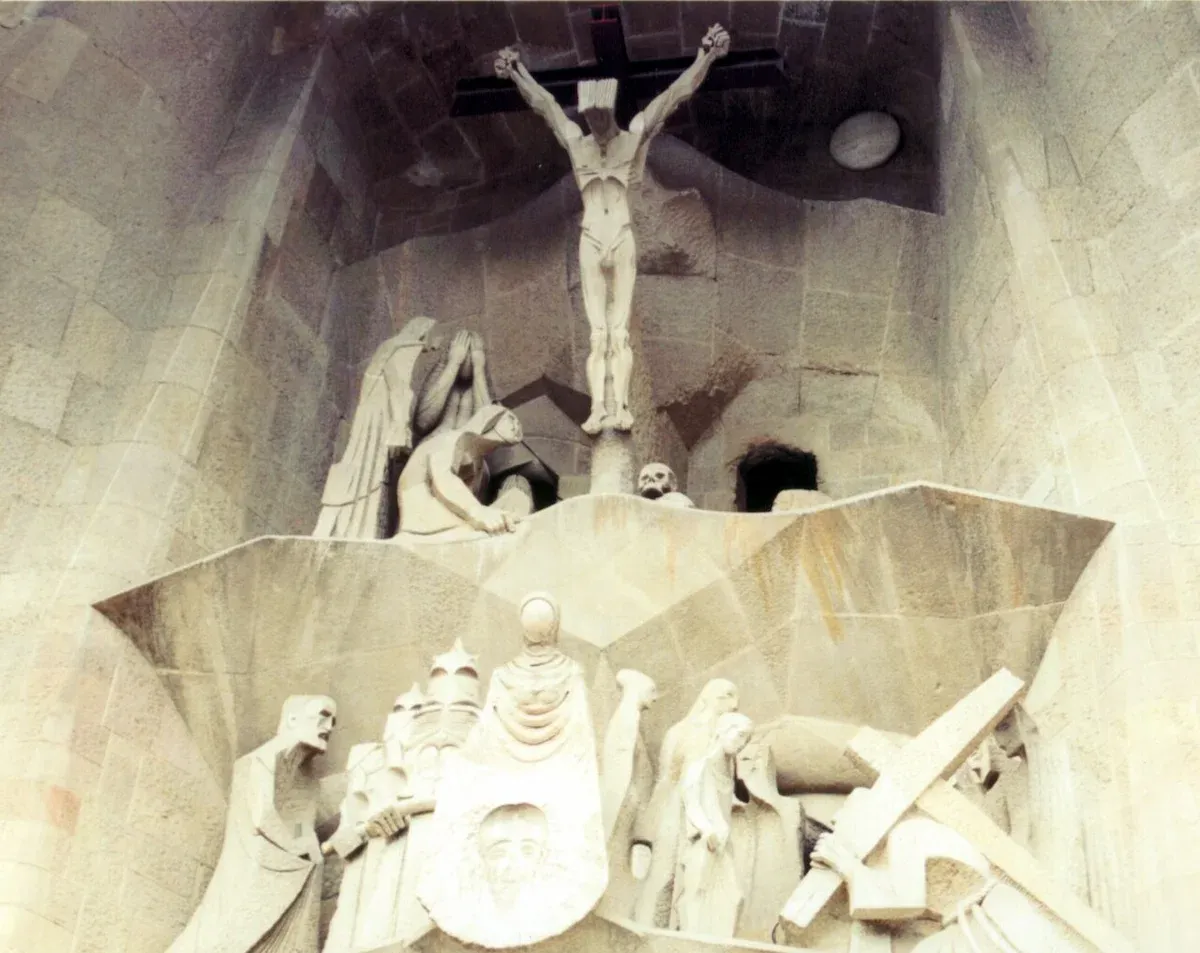
Eighteen sculptural groups by Josep Maria Subirachs line the Passion Facade of the Sagrada Familia, arranged across three levels. The facade was built between 1954 and 2018 from sketches by Antoni Gaudi. Its stripped-back severity stands opposite the ornate Nativity Facade on the other side of the basilica.
18 sculptures by Subirachs
Josep Maria Subirachs carved 18 angular sculptural groups across three levels between 1986 and 2018, from Gaudí's 1911 sketches.
Built 1954–2018, west-facing
Stonework started in 1954 and finished in 2018; the facade faces west, turning amber through Vila-Grau's stained glass in the afternoon.
4 apostle towers, 75 m high
Separate ticket unlocks 4 of the 12 apostle towers, ~75 m tall, with a 20–30-minute spiral descent over the sculptures.
What story does the Passion facade tell?
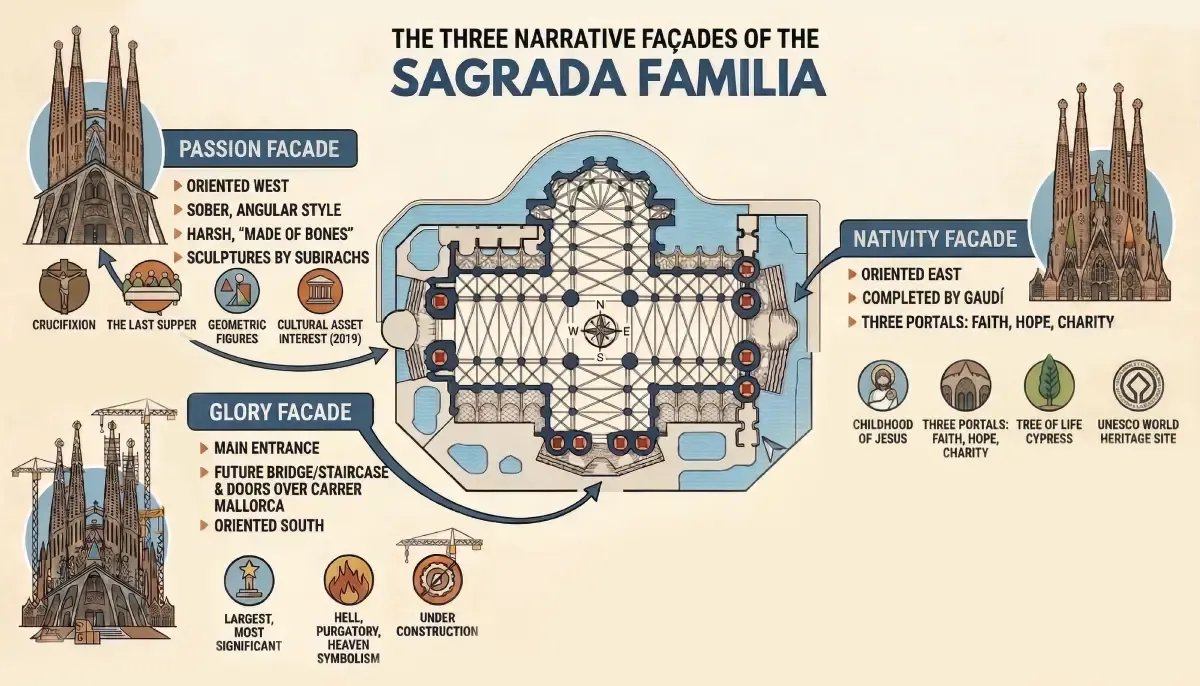
What story does the Passion facade tell?
The Passion Facade (Fachada de la Pasion) of the Basilica de la Sagrada Familia covers the final hours of Jesus Christ. Eighteen bone-like sculptures spread across three levels trace a single narrative: betrayal, trial, crucifixion, burial.
An S-shaped path leads from the lower left corner upward. Ground level holds the Last Supper, the Betrayal, the Flagellation, Peter's Denial. The middle band shows the trial before Pontius Pilate, the road to Calvary, Veronica wiping the face of Jesus. At the top, the crucifixion dominates, flanked by the burial scene and the empty tomb.
On the opposite side, the Nativity Facade celebrates birth and joy through dense organic detail. The Passion Facade does the reverse: death and pain rendered in severe geometric abstraction. Gaudi planned this contrast deliberately.
Who created the Passion facade sculptures?
Josep Maria Subirachs, the Catalan sculptor, carved all eighteen sculptural groups on the Passion Facade between 1986 and 2014. He moved into a studio inside the basilica at the age of 60. For nearly three decades he worked there, producing what became the most debated artistic contribution to the temple.
Antoni Gaudi, the Catalan architect who designed the basilica, drew the first sketches for the Passion Facade in 1911. He wanted broken forms and harsh angles, something that would unsettle rather than please. The facade was meant to be the opposite of the exuberant Nativity Facade. Gaudi knew he would not live to see it built, and he told future artists to interpret his designs freely.
Subirachs did exactly that. His figures have flat planes instead of rounded muscle, and several lack faces entirely. Reaction split from the beginning. Some visitors call the abstracted forms powerful. Others see them as incompatible with the organic language of the rest of the basilica. Subirachs argued publicly that the horror of the Passion called for sculpture that would shock, not comfort. After he died in 2014, his workshop finished the remaining details in 2018.
What are the key sculptures on the Sagrada Familia Passion facade?
Dozens of sculptural elements cover the three levels of the facade. A few draw the most attention, either for their symbolism, their artistry, or the arguments they provoke.
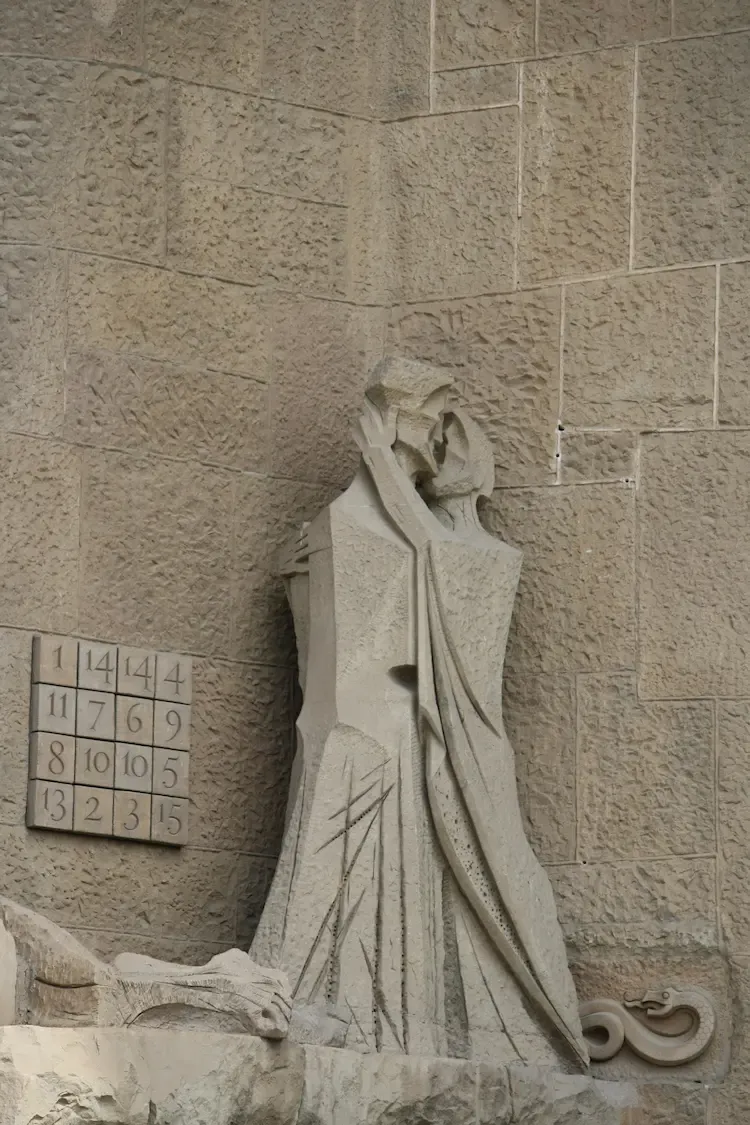
The Kiss of Judas
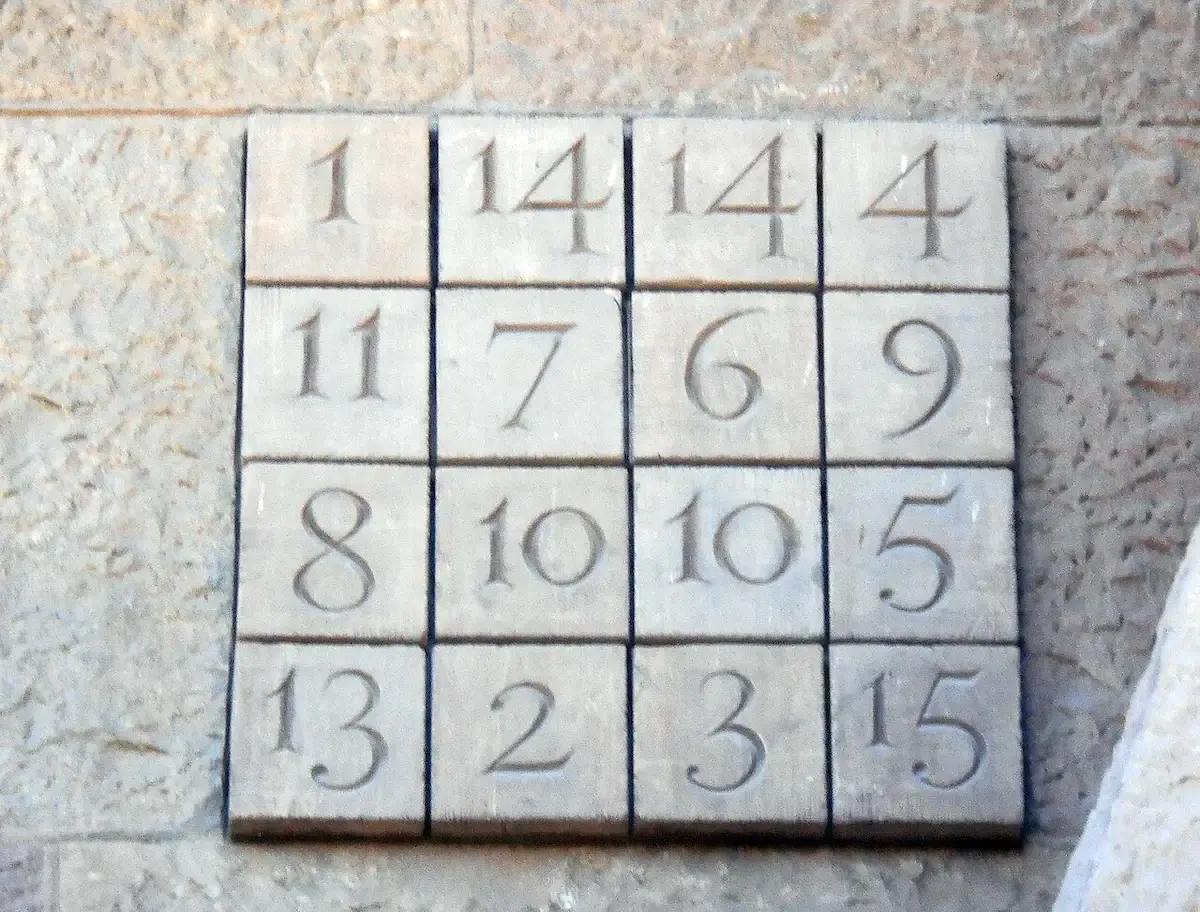
Ground level, centre of the facade. Subirachs carved Judas leaning in to kiss Jesus while Roman soldiers close in from both sides. Behind Judas, a snaking S-shape is cut into the stone. Some read it as a serpent, a symbol of temptation. Others see Subirachs' own signature hidden in the scene. The composition sits at eye level for anyone walking toward the entrance, which is why a guided tour of the Sagrada Familia typically starts here.
What can visitors see from the Passion facade towers?
Four of the basilica's twelve Apostle towers belong to the Passion Facade. Roughly 112 metres tall. Polychrome ceramic finials cap the paraboloid spires and catch light all day. Visitors ride an elevator to the top, then walk down a narrow spiral staircase that passes the sculptural details and the exposed interior of the tower structure.
The Eixample grid stretches out below in every direction. East, the Mediterranean. Southwest on a clear day, Montjuic hill. A stone bridge links two of the towers and gives a straight-down look at Subirachs' sculptures on the facade.
Separate tower access ticket required. Groups are small and entry is timed. No access for visitors with reduced mobility or vertigo. No children under six. The walk down takes 20 to 30 minutes, with narrow stone slits in the walls framing slices of the city.
How does the Passion facade compare to the Nativity facade?
Two of the three facades at the Sagrada Familia exterior are finished. The Passion Facade and the Nativity Facade sit on opposite sides of the basilica.
| Aspect | Passion Facade | Nativity Facade |
|---|---|---|
| Theme | Suffering, death, and resurrection of Jesus | Birth, childhood, and joy of Jesus |
| Sculptor | Josep Maria Subirachs (1986-2018) | Antoni Gaudi (1892-1930) |
| Style | Angular, geometric, stripped-down forms | Naturalistic, organic, highly detailed |
| Supervised by Gaudi | No (built from his sketches after death) | Yes (the only facade completed under his direction) |
| UNESCO status | Not part of the 2005 inscription | Part of the 2005 inscription |
| Tower views | City grid, Mediterranean coastline | Placa de Gaudi, Eixample rooftops |
| Emotional register | Stark, confrontational, austere | Warm, celebratory, abundant |
Enter from the Nativity side in the morning and blue-green light floods the nave. Come back through the Passion entrance in the afternoon and everything turns amber. Joan Vila-Grau designed the stained glass windows so the colour shifts as the sun moves. The interior of the Sagrada Familia looks and feels different depending on the hour and the door.
On Carrer de Mallorca, the Sagrada Familia Glory Facade is still going up. Largest of the three. It will eventually replace both side facades as the basilica's main entrance.
When was the Passion facade built?
Francisco de Paula del Villar started the Sagrada Familia in 1882. Gaudi replaced him in 1883 and threw out the neo-Gothic plans, redesigning the project from scratch. By 1911 he had drawn detailed sketches for the Passion Facade, though he knew the work would outlast him.
A tram struck and killed Gaudi in 1926. He had spent his last fifteen years on the basilica and nothing else. The Spanish Civil War destroyed part of his plaster models and drawings, but enough survived. Architects used them to build the structural shell of the Passion Facade starting in 1954, and the stonework was done by 1977.
Subirachs arrived in 1986. He set up a studio inside the basilica and spent the next twenty-eight years carving the eighteen sculptural groups. Most were in place when he died in 2014. His workshop added the final pieces in 2018.
The Passion Facade marked one of the major milestones toward the completion date of the Sagrada Familia, a project now over 140 years old. Pope Benedict XVI consecrated the basilica in 2010 while builders worked around the ceremony. Construction on the central tower of Jesus Christ and the Glory Facade continues today.
Main photo for this content: “Passion Façade” by Joe Shlabotnik