
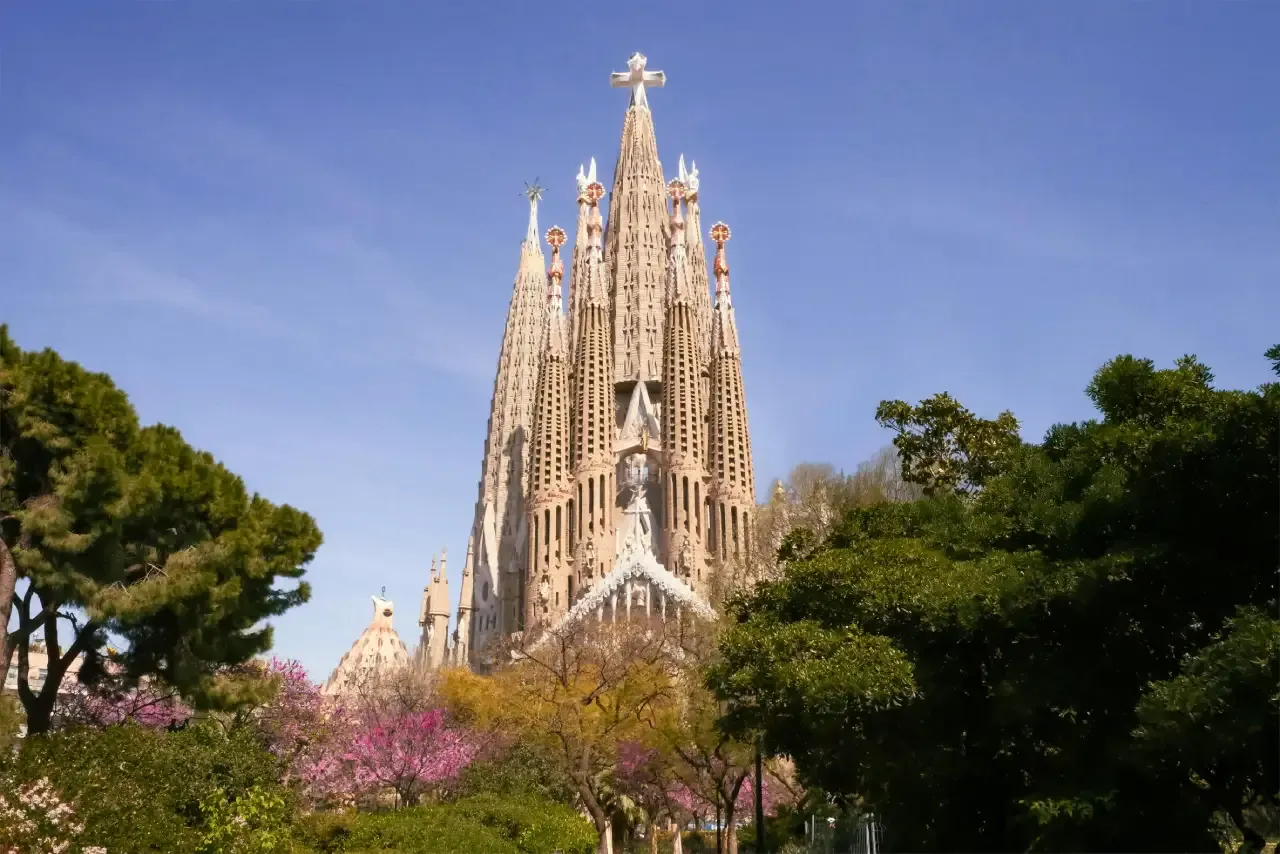
The Sagrada Familia cross on the tower of Jesus Christ
The Sagrada Familia cross now crowns the tower of Jesus Christ. This 17-metre landmark completes the central tower's exterior and brings Antoni Gaudí's vision to life. Its installation in February 2026 signals a historic milestone in the basilica's long construction.
Support when you need it
Customer support to assist you with everything you need from 8:00 AM to 7:00 PM.
Fast and online booking
Choose the ticket that fits your needs and preferences, and skip the lines by booking here.
Top attraction in Barcelona
Explore the city's most iconic basilica and delve into decades of architectural history.
The cross on the Tower of Jesus Christ
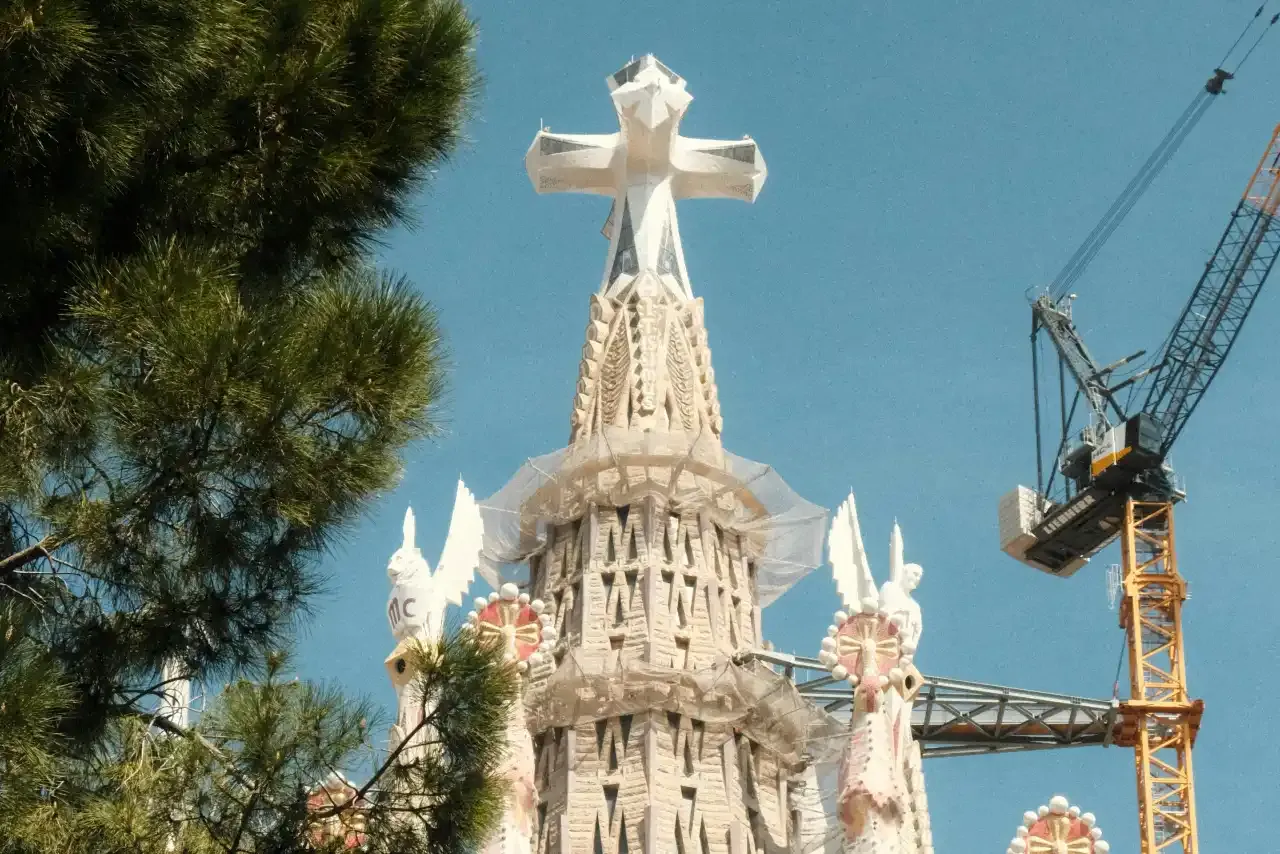
The cross on the Tower of Jesus Christ
The Tower of Jesus Christ stands at 172.5 metres, making it the tallest of the eighteen planned towers. Antoni Gaudí designed this height to remain one metre below Montjuïc hill, ensuring the building does not surpass the natural landscape.
At the summit, the Sagrada Familia cross measures 17 metres tall and 13 metres wide. Engineers constructed the cross using tensioned stone segments, which crane operators hoisted and assembled at the apex in early 2026. Visible from across Barcelona, the cross marks the highest point of the basilica and the completion of the central tower's exterior.
How the cross was built and installed
Installation of the 17-metre cross took several months:
| Date | Event |
|---|---|
| October 30, 2025 | Crane operators lifted the lower vertical arm into place. It was the first piece of the cross on the tower. |
| November 7, 2025 | Next came the core element, the central junction connecting all four arms and the upper extension. |
| Late 2025 to early 2026 | Workers bolted the four horizontal arms to the core. Each arm is made of prefabricated stone segments fitted with internal steel tensioning cables, a technique developed for Gaudi's later towers. |
| February 20, 2026 | The crew set the upper arm in place, completing the cross and finishing the exterior of the tower of Jesus Christ. |
Gaudi's tower hierarchy and the 18 towers
Gaudi assigned each of 18 towers to a specific figure from Christian theology. Height determines rank, with the tower of Jesus Christ at the centre and apex:
- 1 tower of Jesus Christ: 172.5 metres. Central, tallest. Topped by the cross.
- 1 tower of the Virgin Mary: 138 metres. Completed in 2021 and inaugurated on December 8 that year, crowned with a twelve-pointed illuminated star.
- 4 towers of the Evangelists (Matthew, Mark, Luke, John): 135 metres each. All four were completed between 2022 and 2023, inaugurated on November 12, 2023.
- 12 towers of the Apostles: Four on each of the three facades (Nativity, Passion, Glory). Ranging from 98 to 120 metres. Eight of the twelve have been completed.
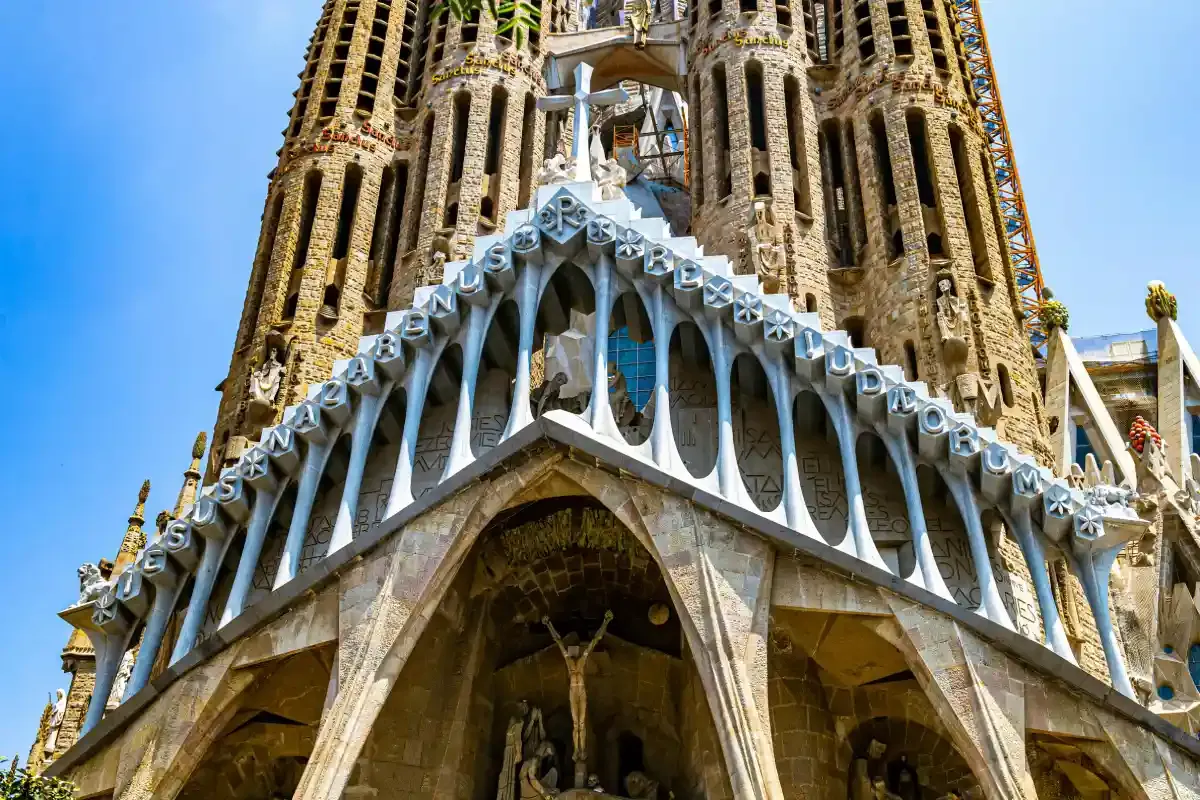
The crucifix on the Passion Facade
The Passion Facade features a stone crucifix at ground level, contrasting with the Sagrada Familia cross atop the central tower. Sculptor Josep Maria Subirachs carved the figure of Christ from travertine stone between 1986 and 2009, utilizing angular forms to depict the crucifixion. This aesthetic differs from the naturalistic style of the Nativity Facade.
Eighteen sculptural groups surround the crucifix to narrate the final hours of Christ’s life. Near the Kiss of Judas scene, a stone magic square contains numbers that sum to 33 in every direction. While the tower cross symbolizes triumph, this facade crucifix represents sacrifice. Together, these two structures incorporate the dualities of the Christian narrative into the basilica’s architecture at different elevations.
Best viewpoints for the tower cross
The tower cross is visible across Barcelona. These locations offer the clearest sightlines:
- Plaça de Gaudi (the park across Carrer de la Marina): Faces the Nativity Facade head-on with the tower of Jesus Christ behind it. The reflecting pool gives a mirror image of both.
- Carrer de la Marina (east side): Walking along the eastern boundary of the basilica gives a clear sightline to the tower and cross without obstruction from scaffolding on the Glory Facade side.
- Avinguda de Gaudi: The pedestrian boulevard connecting Hospital de Sant Pau to the Sagrada Familia frames the tower cross at the end of a direct visual axis.
- Inside the basilica: Standing in the central nave and looking upward through the hyperboloid columns, visitors can see the base of the tower of Jesus Christ rising above the vault. The cross sits on the exterior summit and is not visible from inside, but the tower structure fills the view from below. The stained glass windows cast coloured light across the interior during this upward view.
- Bunkers del Carmel: This panoramic viewpoint 3 km north gives a wide-angle perspective of the Barcelona skyline with the Sagrada Familia at its centre. The tower cross is visible against the sea horizon.
Visitors obtain the best light on the Sagrada Familia cross by visiting in the morning, when the sun illuminates the eastern Nativity Facade. Afternoon light strikes the Passion Facade side, providing a different perspective of the same structure. Travelers can check the best time to visit the Sagrada Familia for seasonal guidance regarding lighting conditions.
What the cross means for the completion timeline
Construction of the Sagrada Familia began in 1882 under Francisco de Paula del Villar before Antoni Gaudí assumed control. Gaudí only witnessed the completion of the Saint Barnabas bell tower in 1925. Following the Spanish Civil War, which halted work and destroyed original models, Francesc de Paula Quintana led the reconstruction efforts.
The installation of the Sagrada Familia cross in February 2026 marked the end of vertical construction on the central body. This milestone occurs 144 years after the first stone was laid. Work now shifts to the Glory Facade and interior finishing, with total completion projected for 2033. The basilica’s skyline now reflects Gaudí’s intended vision, featuring the structural crown he designed over a century ago.