
Sagrada Familia (Barcelona)
The Basilica of the Sagrada Familia is Antoni Gaudí's unfinished expiatory church in Barcelona's Eixample district. Construction started on 19 March 1882 and continues today, because donations and ticket sales pay for the works. Gaudí ran the project from 1883 until his death in 1926. His plaster models shape current construction. UNESCO inscribed the Nativity Facade and Crypt in 2005, and Pope Benedict XVI consecrated the church on 7 November 2010.
Planned height
172.5 m at the central Jesus tower, above Ulm Minster's 161.5 m record for a completed church.
Tower count
18 spires: 12 for the apostles, 4 for the evangelists, 1 for the Virgin Mary, 1 for Jesus Christ.
Ruled geometries
Hyperboloids, hyperbolic paraboloids, helicoids, and conoids replace the Gothic buttress system.
Architecture of the Sagrada Familia
Architecture of the Sagrada Familia
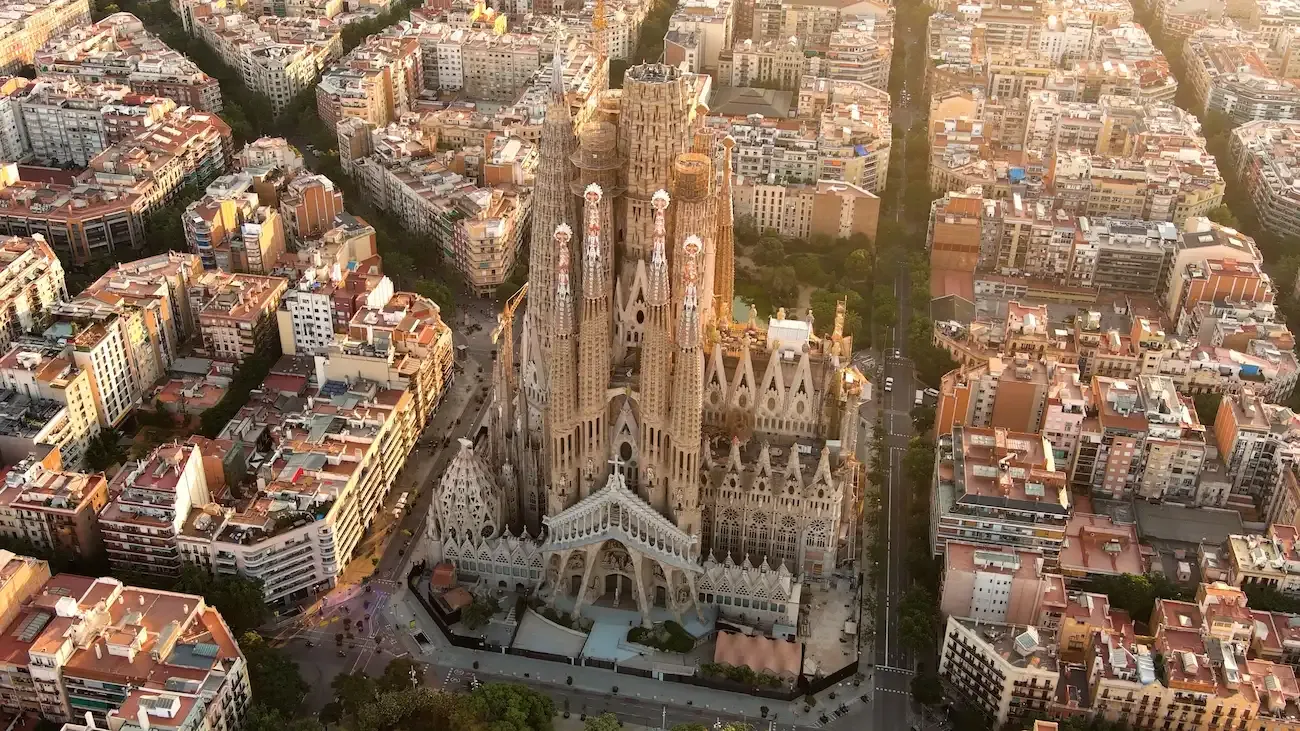
Gaudí conceived Sagrada Familia as a stone forest built on ruled geometry. Hyperboloids, hyperbolic paraboloids, helicoids, and conoids carry the loads, and the interior stands without exterior buttresses. The tree-like columns branch at the top. Four stone types appear in the column system, each matched to its position by compressive strength. Porphyry supports the four central columns that carry the Jesus tower. Basalt takes the next ring, granite the nave columns, and Montjuïc sandstone the outermost positions. Joan Vila-Grau calibrated the stained-glass windows to a chromatic programme: cool blues and greens for the east Nativity side, warm reds and oranges for the west Passion side. The sacred geometry of the basilica scales the 18 towers. Jesus' 172.5 m central spire rises above Mary's, Mary's above the four evangelists, and the evangelists above the twelve apostles.
History of the Sagrada Familia
Construction started on 19 March 1882 under Francisco de Paula del Villar. Villar drew a neo-Gothic crypt and resigned in 1883 after disagreements with the project's promoter Josep Maria Bocabella. Antoni Gaudí took over on 3 November 1883 and redrafted the design around ruled geometry. He ran the works until 7 June 1926, when tram number 30 struck him on Gran Via de les Corts Catalanes. He died three days later; his tomb sits in the Crypt's Chapel of Our Lady of Carmel.
The Spanish Civil War halted construction in 1936. Anarchists burned the workshop and destroyed Gaudí's plaster models and drawings. Successors rebuilt the models from surviving fragments. Architects resumed the works in the 1950s. After 1990, 3D modelling and rising ticket revenue accelerated construction. The pinnacle cross of the Passion Facade and the topped-out Jesus tower mark the two most recent structural milestones. Permits, engineering approvals, and fundraising set the pace of the remaining works. Separate pages cover why the basilica remains unfinished and the current finish-date projection.
Gaudí, the architect of Sagrada Familia, and his successors
Antoni Gaudí assumed leadership in 1883 at age 31. He transformed the original plans into a vision inspired by nature and Christian symbolism. From 1891, he focused on the Nativity façade, and by 1914 he dedicated his career exclusively to the basilica. Gaudí spent 43 years shaping the structure and lived in the onsite workshop during his final years. At the time of his death in 1926, construction had only completed the crypt, the apse, and one tower.
Gaudí understood the basilica would require centuries to complete and intentionally left space for future architects to contribute. His assistant, Domènec Sugrañes, finished the remaining Nativity towers. Later, Francesc de Paula Quintana resumed work after the Spanish Civil War, recovering fragments of Gaudí’s original models. During the 1950s, Gaudí’s disciples Isidre Puig Boada and Lluís Bonet i Garí advanced the project, completing the Passion façade towers in 1976. In 1985, Jordi Bonet i Armengol introduced computer-aided design, a transition that allowed for the precise execution of Gaudí’s complex geometries. Since 2012, Jordi Faulí has led the final stage, overseeing the completion of the Tower of the Virgin Mary in 2021 and the Evangelists’ towers in 2023.
How long has Sagrada Familia been under construction?
The Sagrada Familia has remained under construction for over 140 years due to several factors. The scale of the design includes 18 towers, detailed façades, and a vast interior. Unlike medieval cathedrals supported by state or church funds, the Sagrada Familia functions as a temple financed solely by private donations and ticket sales. Consequently, economic fluctuations have historically influenced the pace of construction.
The destruction of Gaudí’s original models and drawings in a 1936 fire during the Spanish Civil War also delayed progress. Architects spent decades reconstructing his concepts from fragments, photographs, and notes. Furthermore, the structural complexity required modern technology, such as 3D modeling and CNC stone-cutting, which became available only in recent decades.
With the completion of the Tower of Jesus Christ, the Sagrada Familia officially becomes the tallest basilica in the world. Reaching its final height of 172.5 meters, the central tower's structural completion marks the 2026 centenary of Antoni Gaudí’s death. While the primary towers are now complete, work on the Glory façade and its monumental staircase continues, with final project completion estimated for the 2030s.
The three narrative façades of the Sagrada Familia
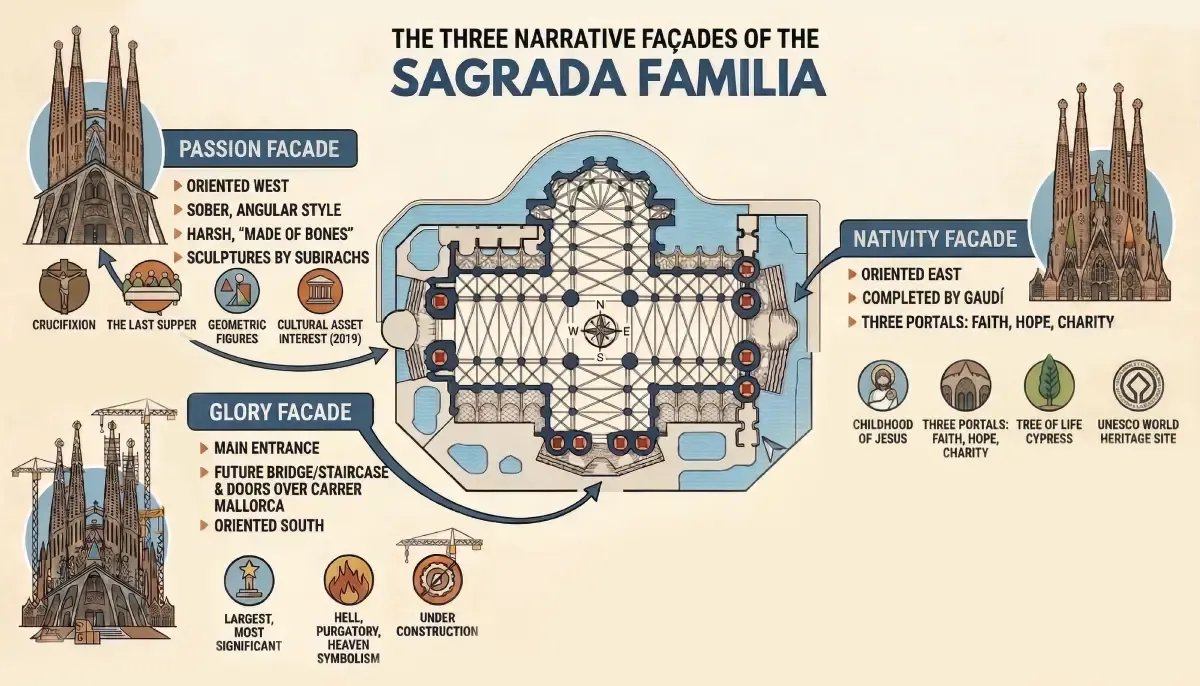
The basilica has three facades. Each one narrates a phase of the life of Christ. Gaudí completed one of them in his lifetime: the eastern Nativity Facade. Plant, animal, and human figures crowd its panels around scenes of the Birth and early years of Jesus. Josep Maria Subirachs sculpted the western Passion Facade from 1987 until his death in 2014. He rendered the Crucifixion, the Betrayal, and Peter's Denial in austere angular figures that contrast with the Nativity's baroque density. The southern Glory Facade will be the main entrance once finished. Sculptures of the Final Judgement and Resurrection will fill its portal. The three facades of the Sagrada Familia form a coherent iconographic programme, with each tower and portal mapping to a specific narrative moment.
This infographic details the orientation, history and key elements that define Gaudí’s spiritual narrative on the Nativity, Passion and Glory façades:
Nativity façade
Nativity façade
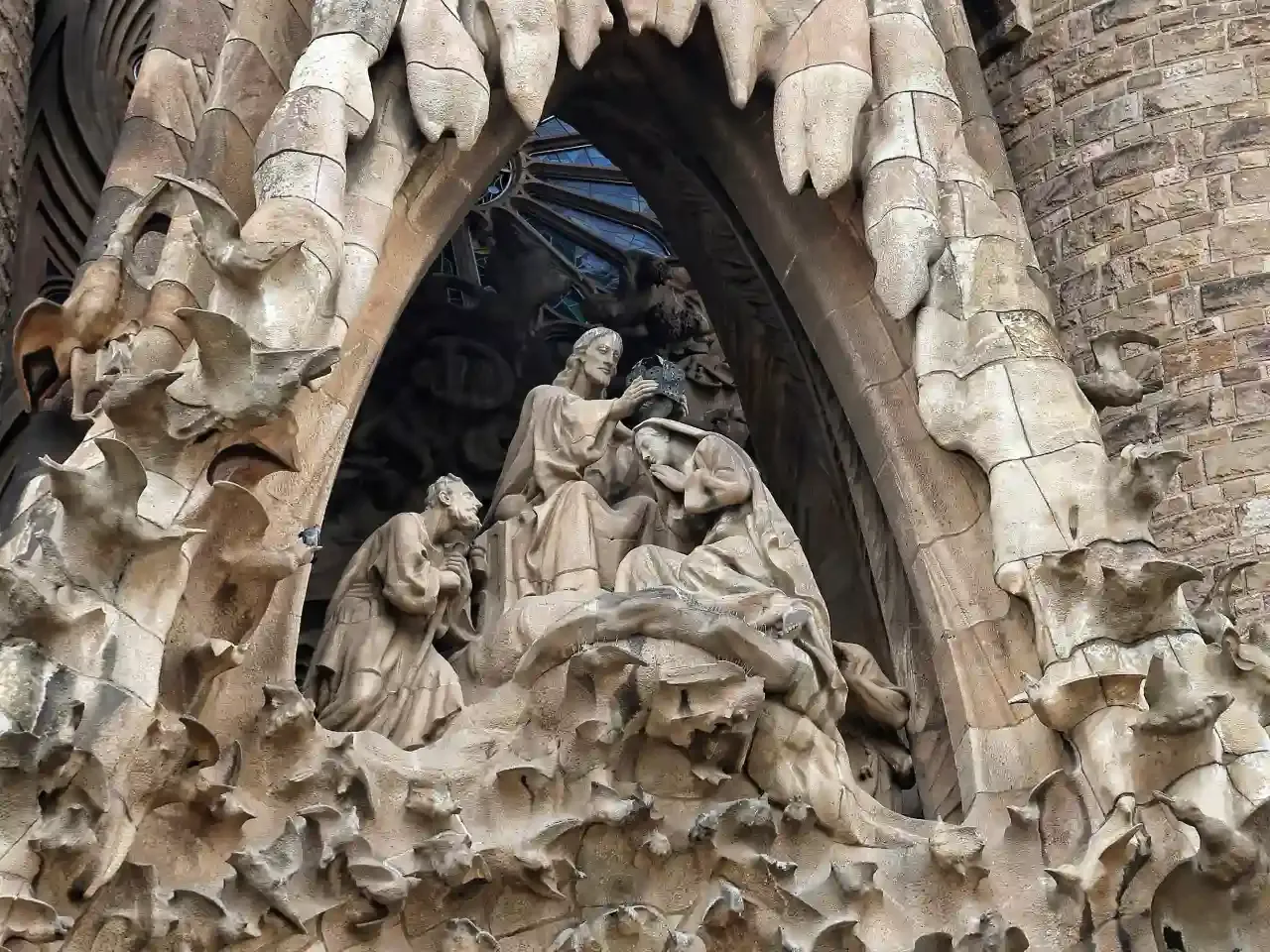
Facing east, this is the only façade Gaudí saw completed during his lifetime, and he chose to start with it for its luminous and optimistic character. It represents the childhood of Jesus and is divided into three portals dedicated to Faith, Hope, and Charity. Every inch is covered in naturalistic symbols: local flowers, birds, reptiles, and biblical scenes carved with realism, turning the whole into a stone nativity scene.
Above the central portal rises the Tree of Life, a cypress crowned with symbols of the Trinity and surrounded by doves representing ascending souls. Between 2014 and 2015, the façade was completed with the polychrome bronze doors by Etsuro Sotoo, decorated with ivy, lilies, fish, and thornless roses that seem to come alive at the touch. Since 2005, this façade has been listed as a UNESCO World Heritage Site.
Passion Façade
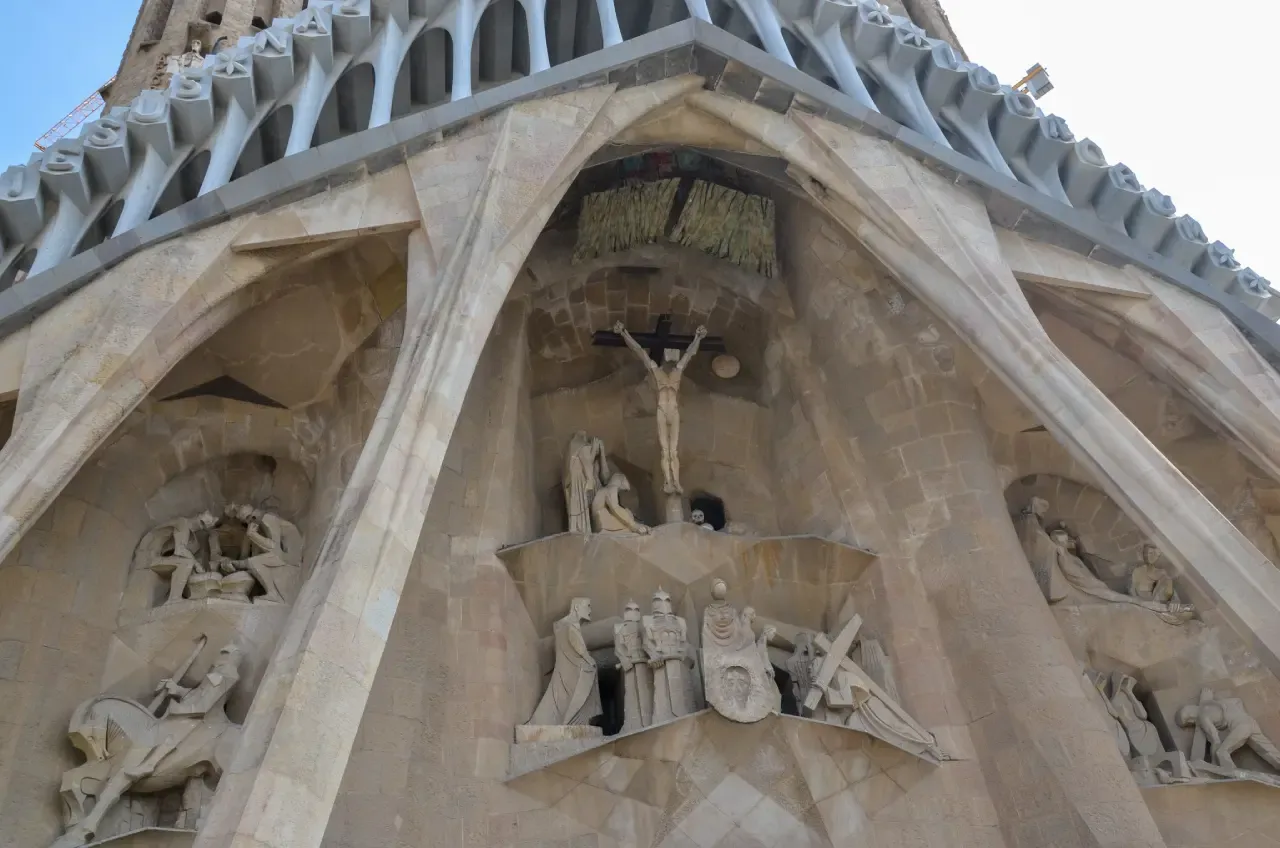
The Passion Façade presents a sober, angular style. Gaudí envisioned it as “harsh, like made of bones” to convey the tragedy of Christ’s final days. Its six bare columns resemble dry sequoia trunks, and the sculptures by Josep Maria Subirachs (1987–2005) stand out for their modern expressionism: geometric figures, tense faces, and dramatic compositions such as the flagellation or the descent from the cross.
Among its most famous details is the “magic square”, where every row and diagonal adds up to 33, the age of Jesus. Inaugurated in 2018, this façade has become one of the most distinctive parts of the temple and was recognized as a Cultural Asset of National Interest in 2019.
Photo: “Passion Façade” by Joe Shlabotnik.
Glory Façade
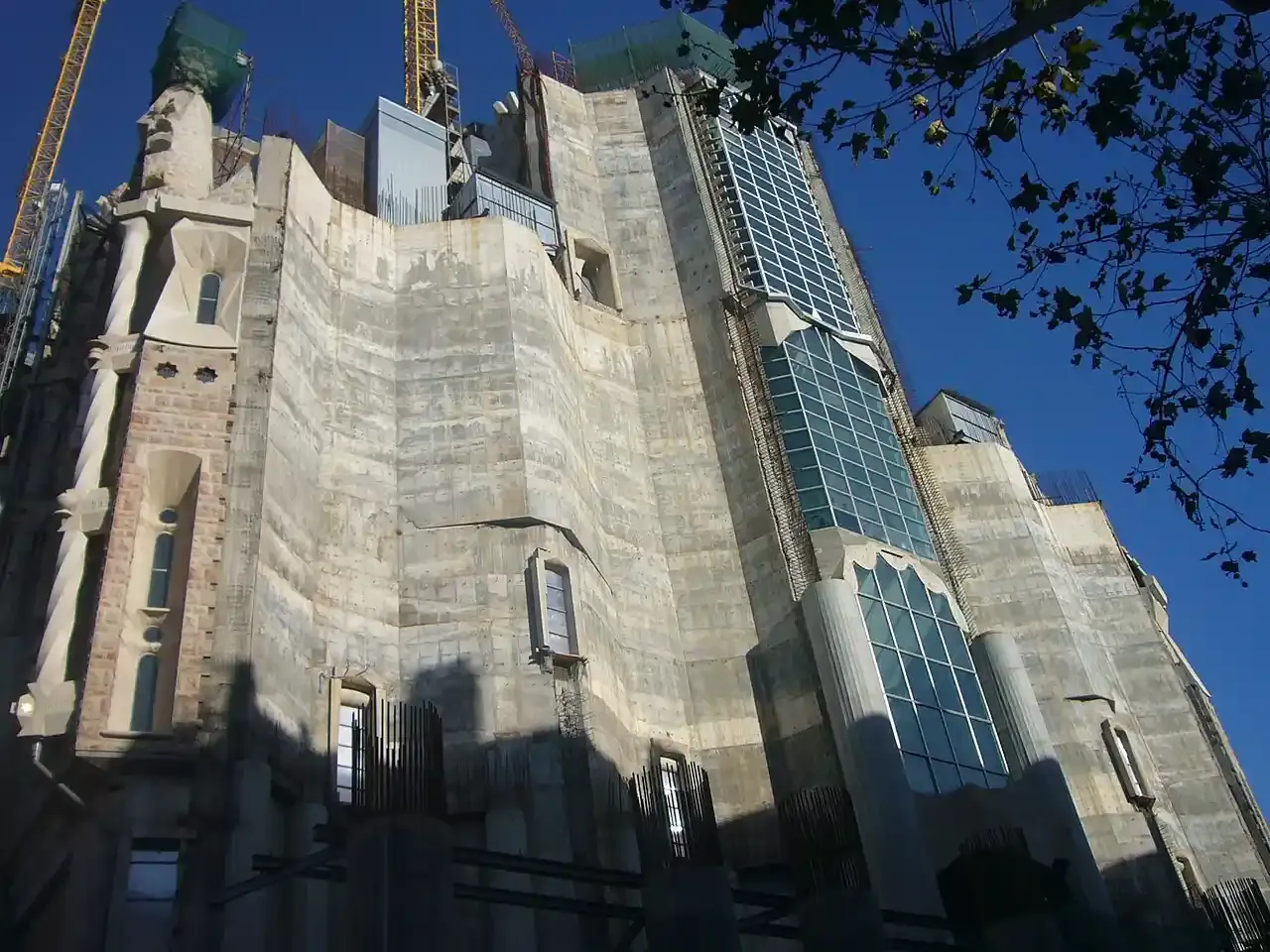
Glory Façade
The Glory Façade serves as the principal entrance to the Sagrada Familia, situated on the southern side facing the Mediterranean Sea. As the largest and most significant of the three façades, it represents the path toward eternal glory and functions as a monumental architectural catechesis on human salvation.
Antoni Gaudí designed the sculptural program to narrate the spiritual journey from the origins of humanity with Adam and Eve to the finality of the Last Judgment. The structure incorporates a vast atrium and a porch designed to symbolize the theological realms of Hell, Purgatory, and Heaven. This sector, which remains under construction into the 2030s, will eventually feature a monumental staircase and seven bronze doors representing the sacraments.
Photo: “Glory facade - Sagrada Familia 2011” by Jordiferrer.
Inside the basilica
Inside, the central nave rises to 45 m and the transept to 60 m, with the crossing vault at 75 m below the central Jesus tower. The tree-like columns split into tilted branches and meet hyperboloid vaults overhead, without the pointed arches of Gothic interiors. Coloured light from the side aisles shifts through the day. Warm tones enter through the Passion side in the afternoon, while cooler tones fill the Nativity side in the morning.
The Crypt beneath the apse holds Gaudí's tomb inside the Chapel of Our Lady of Carmel. A baldachin hangs above the main altar from thin cables. Its frame carries a ring of candles and a carved Christ. The interior of the basilica brings ruled geometry, stained glass, and liturgical furniture together under a single vault.
Facts about Sagrada Familia
- The World's Tallest Basilica: with the completion of the Tower of Jesus Christ in 2026, the Sagrada Familia officially became the tallest basilica and religious structure in the world.
- The tallest building in Barcelona: since August 2025, it has surpassed the Mapfre Tower and the Arts Hotel, reaching over 155 meters in height.
- Gaudí and his respect for nature: the central tower will not exceed 172.5 meters so as not to surpass Montjuïc mountain.
- 18 symbolic towers: representing the twelve apostles, four evangelists, Mary, and Jesus. Each tower carries its own meaning.
- The magic square: a unique square where rows, columns, and diagonals always add up to 33, the age of Christ.
- Chromatic interior: stained glass windows designed by Joan Vila-Grau filter natural light to create a specific color atmosphere that shifts according to the sun's position.
- Construction without a permit: Although work began in 1882, the project operated without an official building permit for over 130 years until the City Council finally issued one in 2019.
- The Star of Mary: A twelve-pointed glass and steel star has crowned the Tower of the Virgin Mary since December 2021, serving as a permanent luminous landmark in the Barcelona skyline.
- Gaudí rests in his masterpiece: the architect is buried inside his great work, in the crypt beneath the main altar.
- Built with tickets and donations: it receives no public funding. Its construction relies on private donations and, above all, ticket sales, with millions of visitors every year.
- Interconnected legacy: Beyond the basilica, Gaudí’s influence on Barcelona includes the design of Park Güell, which shares similar organic architectural principles.
Plan your visit to the Sagrada Familia
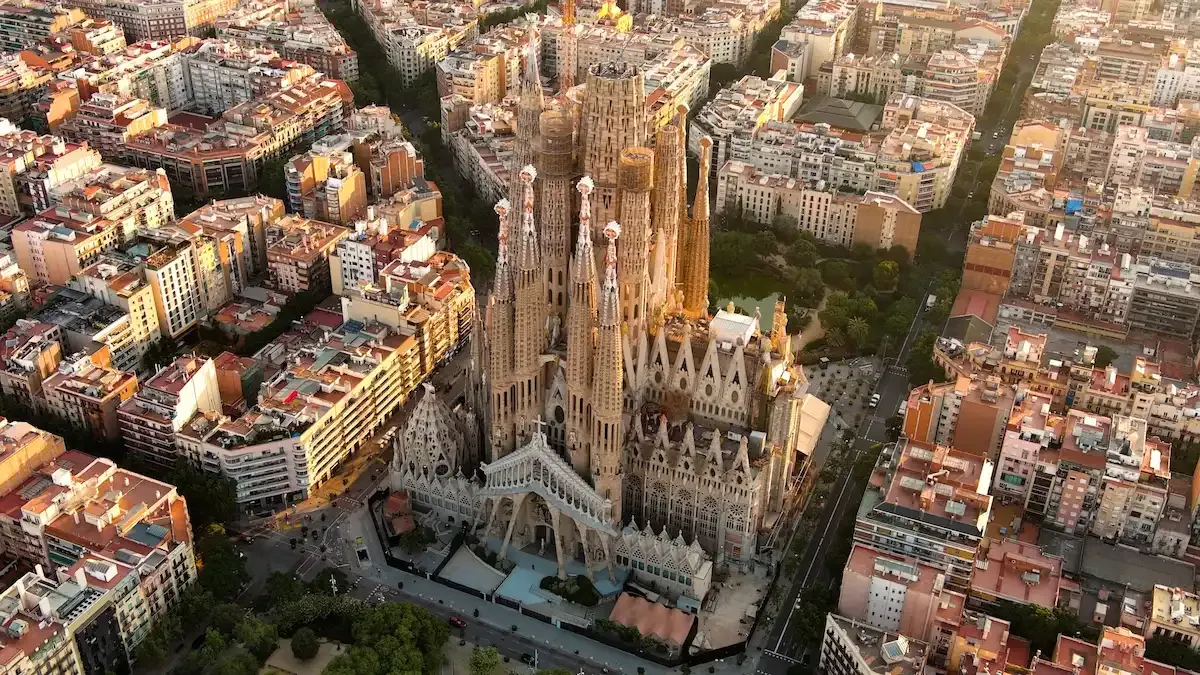
Location
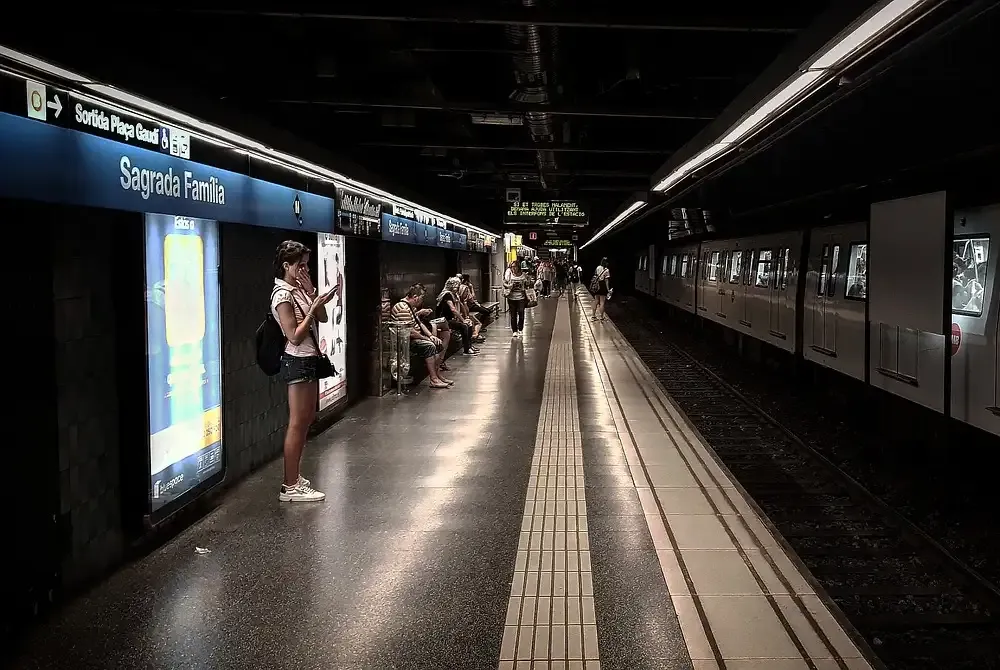
The Sagrada Familia sits at Carrer de Mallorca 401, located in the Eixample district of Barcelona. This location lets visitors navigate the city’s grid of wide avenues and modernista architecture. Immediately adjacent to the building, the Plaça de la Sagrada Família and the Plaça de Gaudí provide spaces to view the facades and spires.
Nearby, the Avinguda de Gaudí offers a pedestrian walkway with cafés and shops that leads toward the Hospital de Sant Pau. This proximity to other landmarks and transport hubs makes the site a focal point for people traveling through the city.
The 18 towers with their symbolism and celestial hierarchies
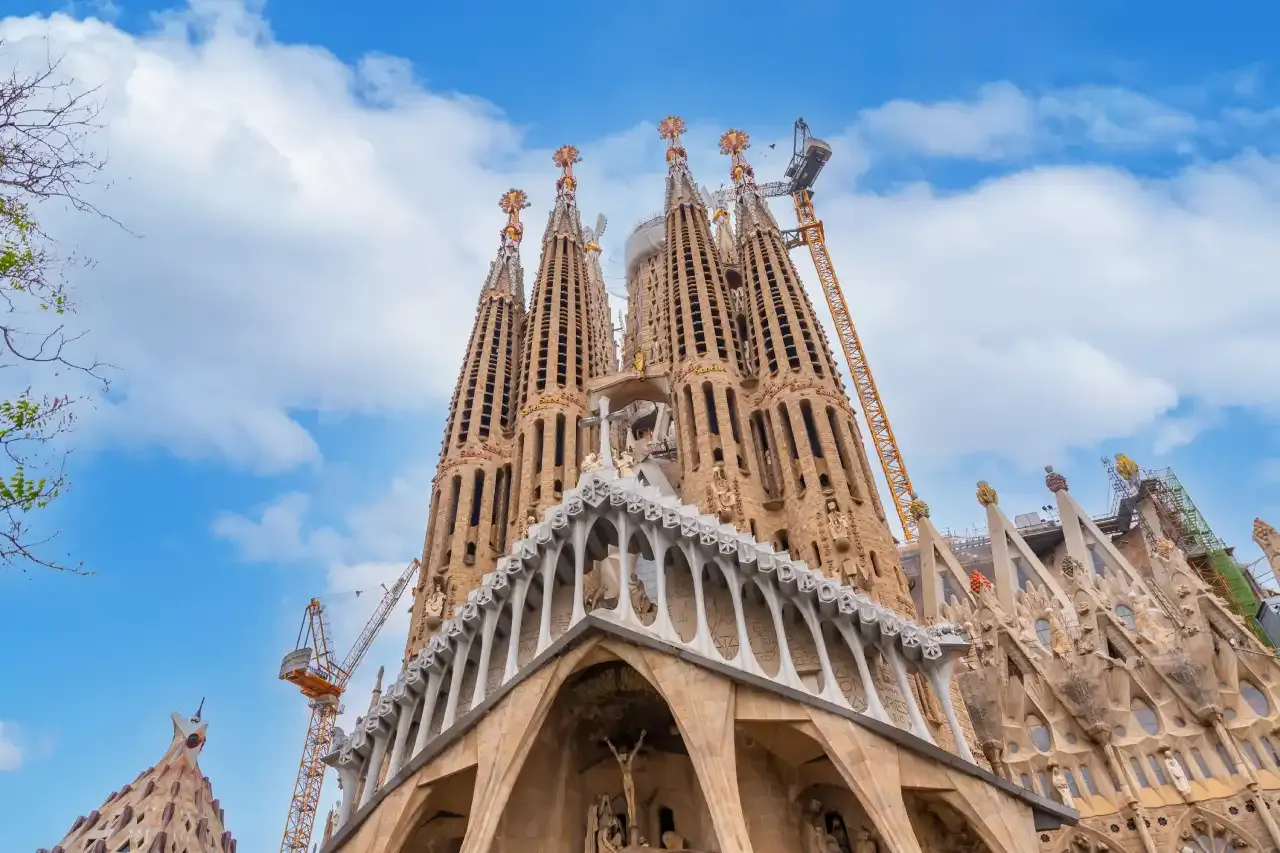
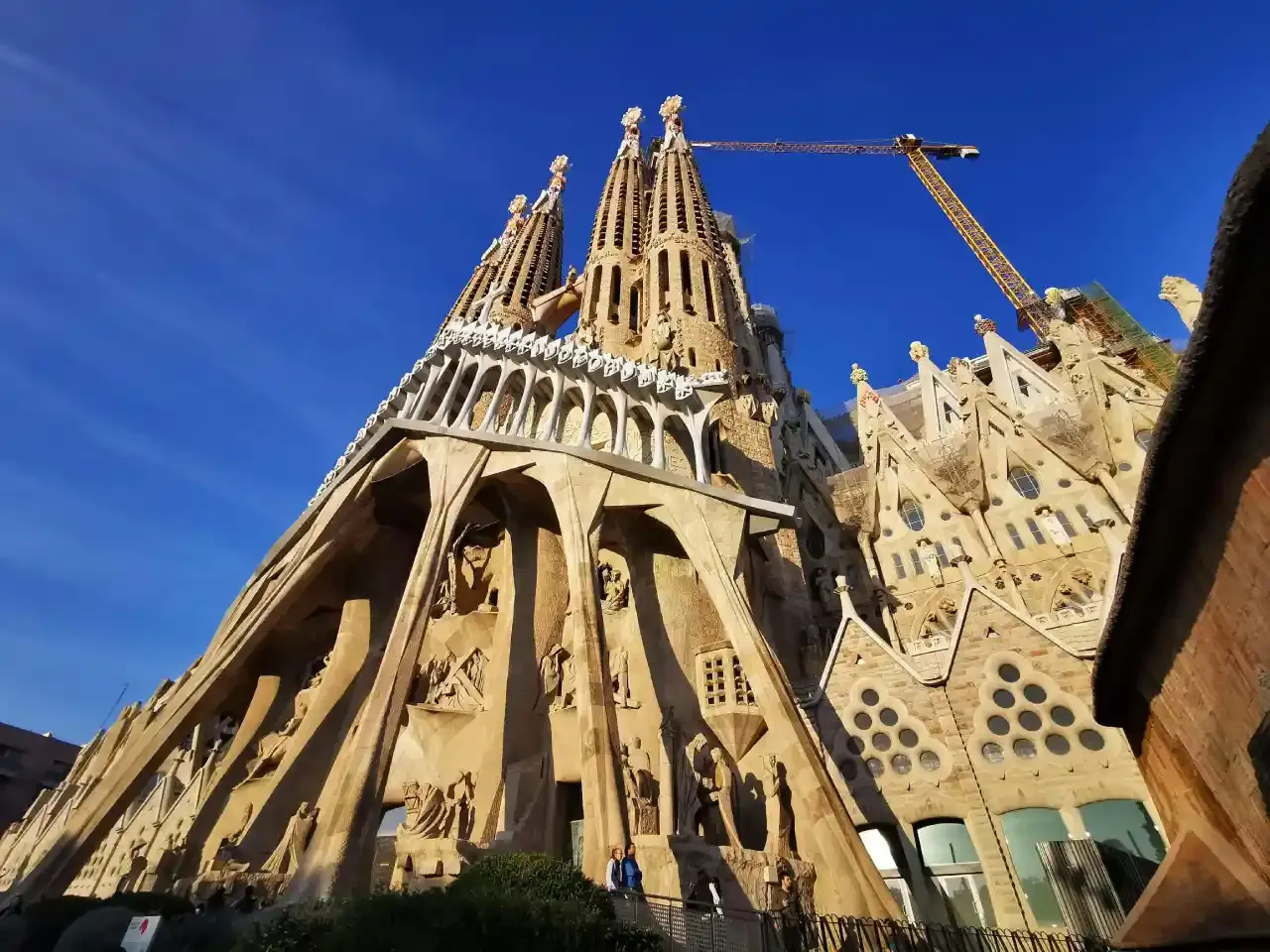
The Sagrada Familia will culminate in 18 towers ordered by spiritual rank: 12 for the Apostles, 4 for the Evangelists, 1 for the Virgin Mary, and 1 central tower for Jesus Christ. This hierarchy is also expressed through height: approx. 98–112 m (Apostles), 135 m (Evangelists), 138 m (Mary), and 172.5 m (Jesus), the symbolic apex of the ensemble.
- Tower of Jesus Christ (172.5 m). Establishing the Sagrada Familia as the tallest basilica in the world. This height remains one meter lower than Montjuïc mountain, adhering to Gaudí’s principle that human architecture should not surpass the works of nature. A large four-armed cross crowns the peak, serving as a prominent landmark visible from most points across the city.
- Towers of the Evangelists (135 m). They encircle the tower of Jesus and are identified by the Tetramorph: eagle (John), angel/winged man (Matthew), lion (Mark), and winged ox (Luke), with the Gospels and inscriptions such as “Alleluia” and “Amen.” Their spires include nighttime illumination.
- Tower of the Virgin Mary (138 m). It stands out for the Morning Star: a 12-pointed star with a 7.5 m diameter that sparkles by day thanks to textured glass and lights up at night; it was inaugurated in December 2021.
- The 12 towers of the Apostles (≈98–112 m). They are arranged four per façade: Nativity (east), Passion (west), and Glory (south). They function as bell towers with polychrome pinnacles and bear each apostle’s name; Gaudí also associated each apostle with a constellation in line with medieval tradition.
The towers on the Nativity and Passion façades are accessible via a specific ticket type, allowing entry to the elevators and the subsequent descent through helical staircases of approximately 400 steps. This route provides panoramic views of Barcelona and a detailed perspective of the upper sculptural elements. Due to the narrow nature of the stairways, this experience is not recommended for those with vertigo or reduced mobility.
The upward progression of these structures expresses the celestial hierarchy of the basilica. The four-armed cross atop the Tower of Jesus Christ, the twelve-pointed star of the Virgin Mary, and the symbols of the Evangelists transform the skyline into an open-air catechetical program. Access to these heights offers one of the most significant vantage points in the city.