
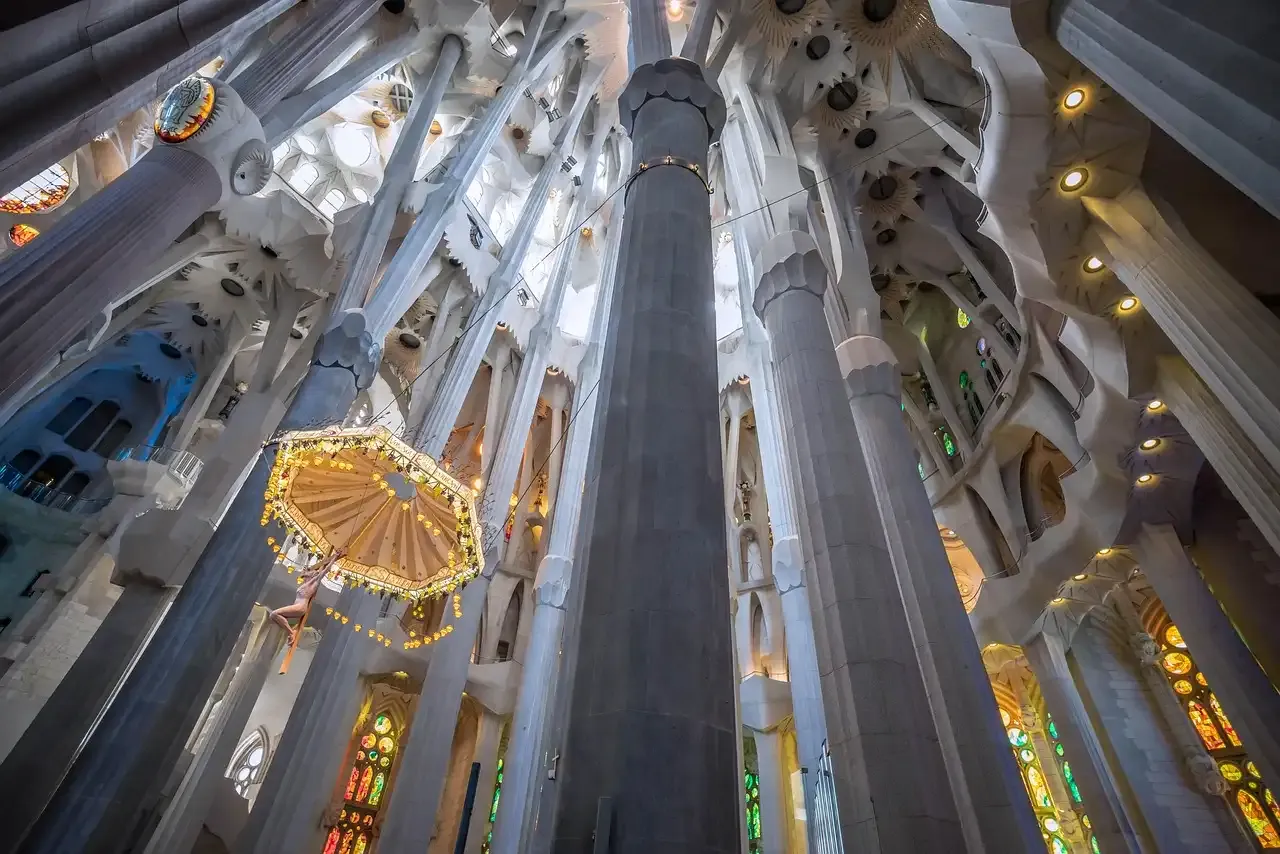
What is the Baldachin and where is it in the Sagrada Familia?
The baldachin of the Sagrada Familia is the ceremonial canopy suspended above the high altar in the apse. Inaugurated on 7 November 2010 during Pope Benedict XVI's consecration, it represents the Holy Spirit through Eucharistic grape vine and wheat motifs. Antoni Gaudi designed the baldachin as the liturgical focal point of the nave. His successors built it decades after his death.
What is the baldachin of the Sagrada Familia?
What is the baldachin of the Sagrada Familia?
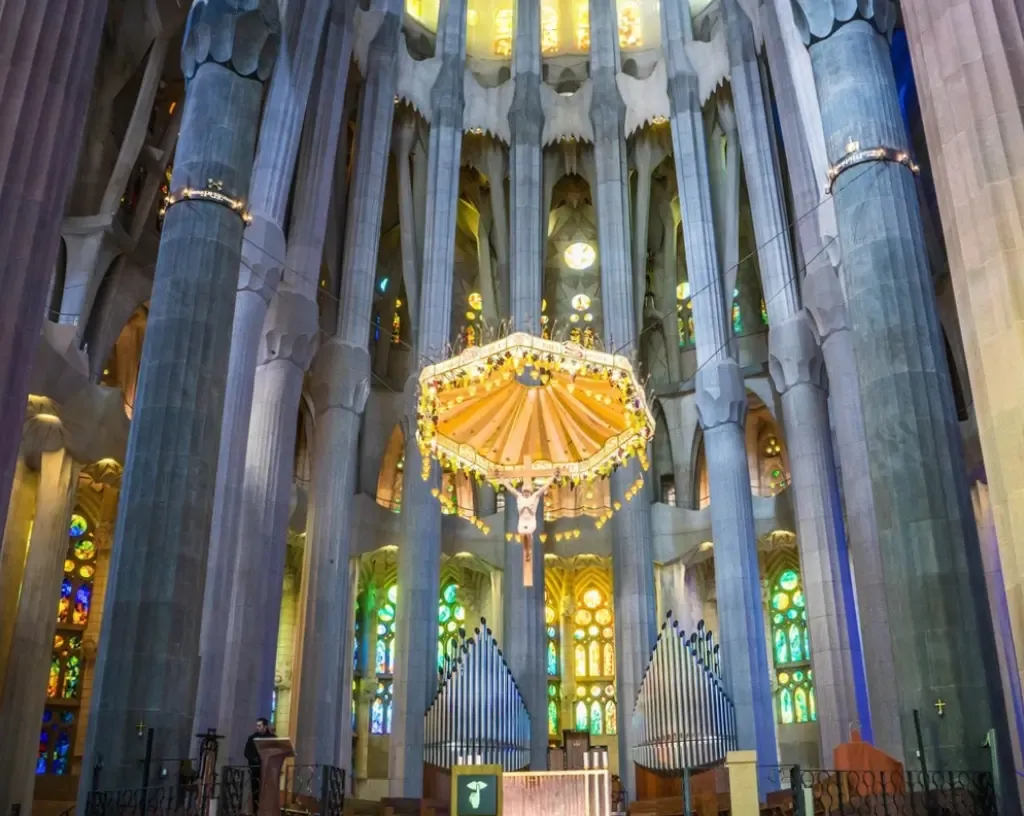
The baldachin of the Basilica de la Sagrada Familia is a ceremonial canopy suspended above the high altar in the apse. Inaugurated on 7 November 2010 when Pope Benedict XVI consecrated the basilica, the baldachin marks the liturgical center of the temple. It is the clearest representation of the Holy Spirit inside the building.
The baldachin sits at the liturgical center of the Sagrada Familia basilica. In Christian architecture, a baldachin (also called a ciborium) is a canopy that marks the sacred space above an altar. The tradition dates to early Roman basilicas. Bernini's 1623–1634 canopy at St. Peter's set the Baroque standard. At the Sagrada Familia, the baldachin carries grape vine and wheat motifs representing the Eucharist. It is the visual anchor of the interior.
What was Gaudi's original design for the baldachin?
Antoni Gaudi, the Catalan architect, envisioned the baldachin as the liturgical focal point of the nave: a canopy framed by branching columns and lit by stained glass on all sides. Gaudi did not initiate the project. Francisco de Paula del Villar, the original architect, designed a neo-Gothic plan with ogival windows and a pointed bell tower. Bishop Urquinaona laid the cornerstone on 19 March 1882. After del Villar's resignation, Gaudi took over in 1883 and became Architect Director on 28 March 1884.
Gaudi reworked the original plan. He drew his approach from nature: trees, bones, hyperboloids. He built three-dimensional scale models instead of detailed drawings and molded details as he conceived them. "This tree by my workshop, this is my master!" he said. The columns surrounding the baldachin follow a geometric progression. The column forest reflects Gaudi's geometry and structural design, where square bases evolve into circles. Each column shifts from a square base through an octagon to a circle as it rises toward the vaults. Visitors near the altar look up through the tree-like columns that support the 45 m vaults. The columns branch at their tops to distribute vault loads on a grid spaced 7.5 metres apart.
From 1915 until his death, Gaudi worked on nothing but the Sagrada Familia. He died on 10 June 1926 at age 73, three days after a tram struck him. The basilica was between 15 and 25 percent complete. Only the crypt, apse, and part of the Nativity facade stood finished. His successors would not complete the baldachin for another 84 years.
Who was Mariano Barcelo, the baldachin's model?
Mariano Barcelo was a stonemason who posed as the model for Gaudi's original crucified Christ design. Gaudi used workers and local residents as models for the basilica's sculptures throughout the project. He made plaster casts from life, and Barcelo's body served as the reference for a Christ figure originally conceived for Casa Bellesguard.
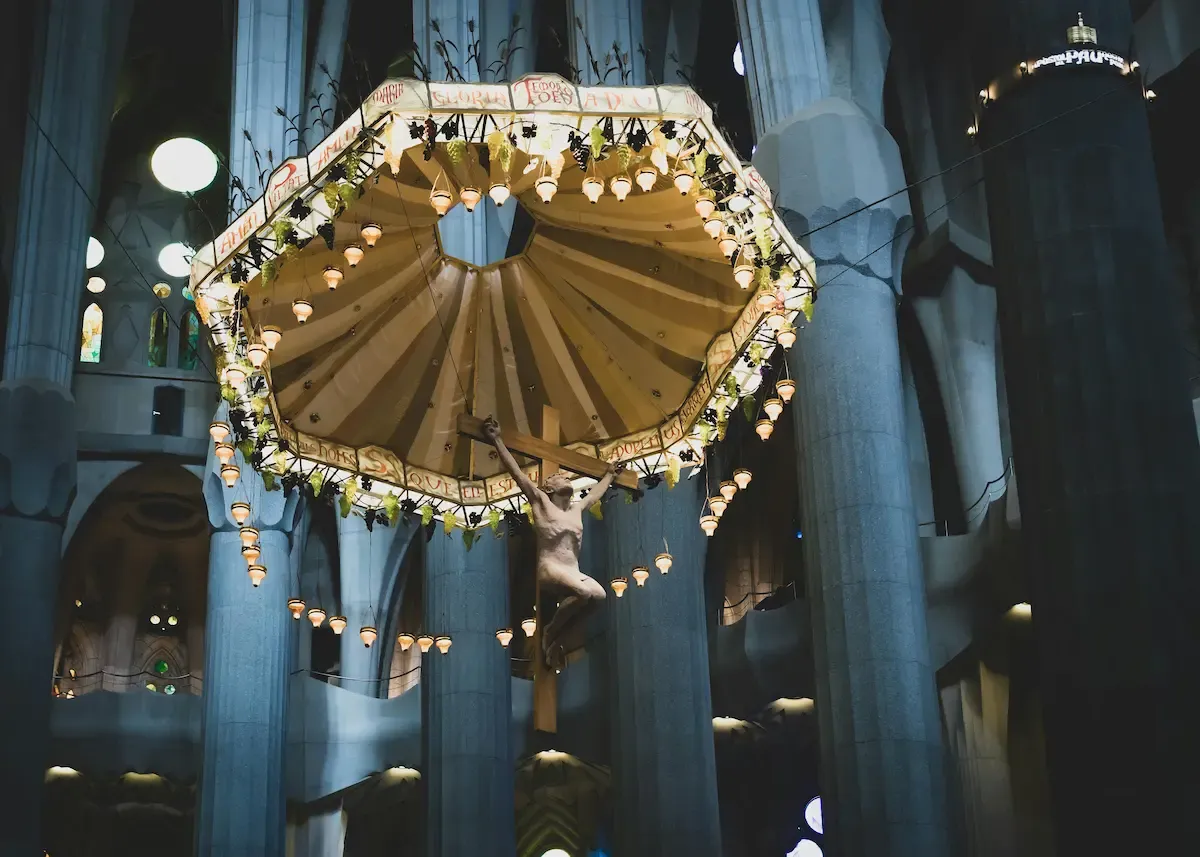
The crucified Christ figure that hangs from the baldachin today was sculpted by Francesc Fajula for the 2010 consecration. Fajula based his work on Gaudi's original design. Visitors notice the figure as soon as they enter the nave.
What do the symbols on the baldachin represent?
The baldachin encodes Christian theology through Eucharistic harvest motifs and the crucified Christ. The canopy itself represents the Holy Spirit.
Grape vines and wheat ears cover the canopy. Grapes represent the wine of the Eucharist (the blood of Christ); wheat represents the bread (the body of Christ). Both crops appear in Christian liturgical art, but here they sit above the altar where priests celebrate the Eucharist. The canopy is the clearest representation of the Holy Spirit inside the temple. It sits between the congregation below and the vaults above.
Light changes how these symbols look throughout the day. Morning sun enters from the east through cool blue-green stained glass and washes the baldachin in muted color. The stained glass windows depict sanctuaries and saints from six continents. As the sun moves west, afternoon light shifts to warm amber-gold. The same space looks different at 10 AM and 4 PM. Gaudi designed this daily color cycle into the interior.
How does the Sagrada Familia baldachin compare to Bernini's at St. Peter's?
St. Peter's Basilica in Rome and the Sagrada Familia in Barcelona hold the two most prominent baldachins in Christian architecture. Gian Lorenzo Bernini, the Italian Baroque sculptor and architect, completed the Roman baldachin between 1623 and 1634. His canopy set the template that later altar canopies followed or reinterpreted.
Bernini's baldachin at St. Peter's stands 28.7 metres tall. Built from bronze stripped in part from the Pantheon's portico, it rises on four spiraling Solomonic columns. It marks St. Peter's tomb below and the papal altar above.
Gaudi reinterpreted the concept three centuries later:
| Feature | Bernini (St. Peter's) | Gaudi (Sagrada Familia) |
|---|---|---|
| Period | 1623–1634 | Designed early 20th century, inaugurated 2010 |
| Material | Bronze with gilt finish | Mixed media with organic forms |
| Column style | Solomonic (spiral) bronze columns | Hyperboloid stone columns surrounding the altar |
| Architectural movement | Roman Baroque | Catalan Modernisme |
| Height of canopy | 28.7 m | Within 45 m central nave vaults |
| Decorative vocabulary | Classical putti, laurel, bees (Barberini heraldry) | Grape vines, wheat, Holy Spirit, crucified Christ |
| Primary function | Marks the tomb of St. Peter and papal altar | Marks the high altar and represents the Holy Spirit |
Both structures mark sacred space above an altar and draw the eye upward. Bernini used mass and bronze. Gaudi used light and organic geometry.
When was the baldachin installed and consecrated?
Pope Benedict XVI consecrated the Sagrada Familia as a minor basilica on 7 November 2010. The baldachin's inauguration was the centerpiece of that ceremony. Inside, 6,500 people filled the nave. Outside, 50,000 followed the Mass, with more than 100 bishops and 300 priests distributing Communion. The altar became active for liturgical use for the first time.
The path from Gaudi's concept to the 2010 inauguration spanned a century. Gaudi died in 1926 with the basilica between 15 and 25 percent complete. Domenec Sugranyes, his main disciple, continued the work until the Spanish Civil War halted construction in 1936. Anarchist militias vandalized the temple, burned Gaudi's plans, and smashed his plaster models.
Francesc de Paula Quintana took over site management in 1939 and began reconstructing the project from saved fragments and published plans. A succession of architects carried the work forward. Foundation work for naves, columns, vaults, and facades began in 1986 and finished in 2010, the year of consecration.
Jordi Fauli, the head architect since 2012, oversees the final phase. On 20 February 2026, the Jesus Christ tower reached 172.5 metres. The Sagrada Familia is now the tallest church in the world.
Where does the baldachin sit within the Sagrada Familia interior?
The baldachin hangs at the crossing of the nave and transept, beneath the central vault 45 metres above the floor. Side nave vaults reach 30 metres. The transept has three aisles. Columns sit on a grid spaced 7.5 metres apart.
The hyperboloid columns surrounding the altar change shape as they rise. Each column starts with a square cross-section at the base, shifts to an octagon, then to a sixteen-sided polygon, then to a circle at the top. Two helicoidal columns twisting in opposite directions create this effect where they intersect. The columns form a stone forest. Branches spread into the vaults and distribute loads, a canopy within a canopy.
Apse, nave, and transept converge at the altar. The baldachin is the liturgical centerpiece of the Sagrada Familia interior. The interior also holds the column forest, stained glass, crypt, and museum.
Overhead, 18 towers represent the Twelve Apostles, four Evangelists, the Virgin Mary, and Jesus Christ, in ascending height. The Jesus Christ tower, topped by a cross, rises 172.5 metres. Gaudi set this height below Montjuic hill because he believed human work should not surpass God's. A vertical axis runs from the crypt below the altar through the baldachin to the tallest tower. Gaudi organized the basilica around this single liturgical line. To witness this architectural masterpiece in person, it is highly recommended to book your Sagrada Familia tickets well in advance.