
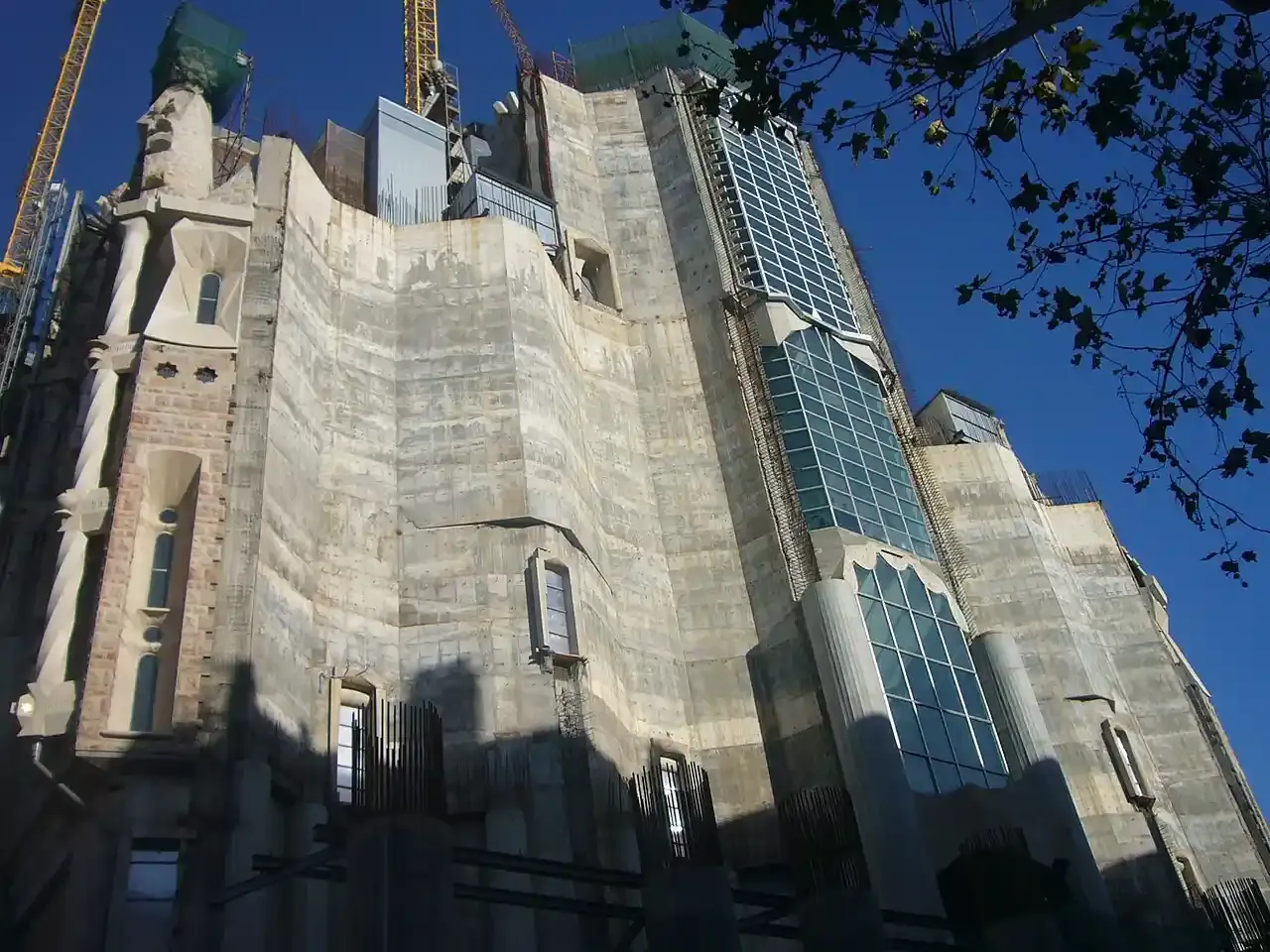
What is the Glory Facade of the Sagrada Familia?
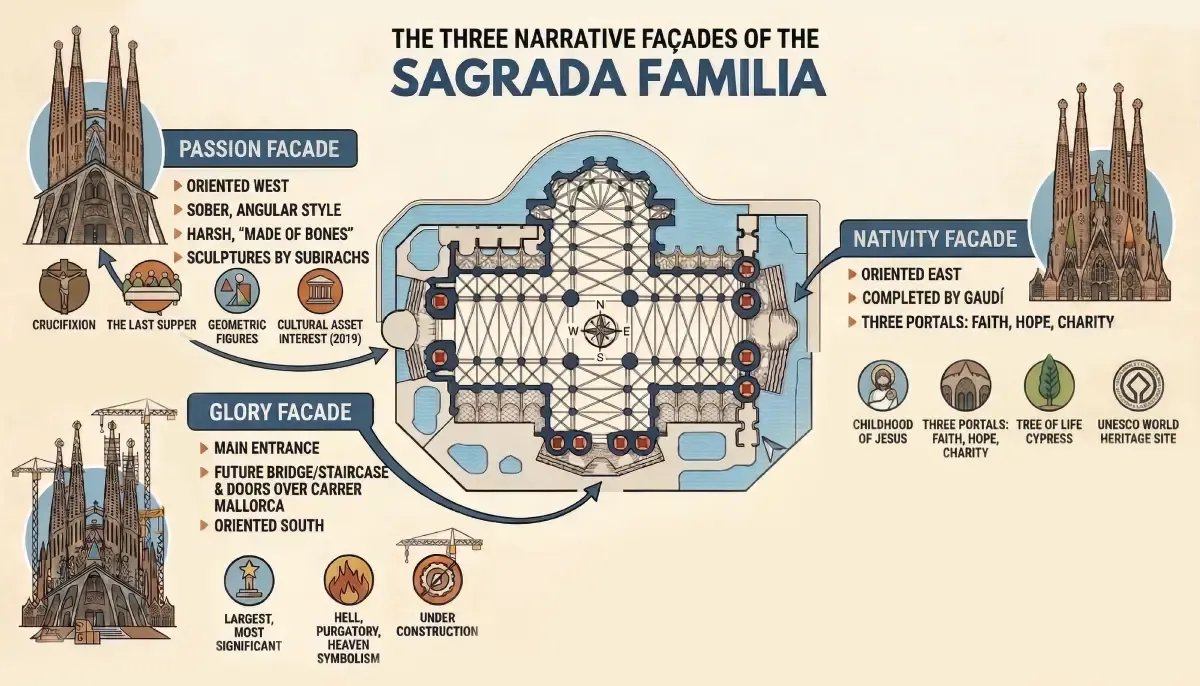
Antoni Gaudí planned the Glory Facade as the building's principal entrance and its largest facade. It faces Carrer de Mallorca on the south side. The Nativity Facade stands on the east, the Passion Facade on the west, and the Glory Facade closes the sequence: birth, death, then eternal glory.
Location & dimensions
The Glory Facade faces southeast onto Carrer de Mallorca, stretches ~60 m wide, and will crown four Apostle towers beneath the 172.5 m Tower of Jesus Christ as the basilica's principal entrance.
Symbolic program
Its program encodes seven columns for the Catholic sacraments, seven bronze doors inscribed with the Lord's Prayer, four towers for Apostles, the seven deadly sins answered by seven virtues, and the Nicene Creed.
Construction & urban conflict
Construction began in 2010, targets completion in the early 2030s, runs on 100% private funding from tickets and donations, and remains blocked by an urban-planning dispute.
What is the Sagrada Familia Glory Facade?
The Glory Facade serves as the main entrance to the Sagrada Familia, located on Carrer de Mallorca. Antoni Gaudí designed it as the largest and most monumental of the three facades on the outside of the Sagrada Familia. It represents the path to God through Death, Final Judgment, and Glory. Construction began in 2002 and remains the final major structural phase of the basilica. The design features seven large columns symbolizing the sacraments of the Holy Spirit. In 2008, workers installed the bronze doors by Josep Maria Subirachs, which display the Lord’s Prayer in over fifty languages, emphasizing its role as the primary spiritual portal.
What did Gaudí envision for the Glory Facade?
During the last decades of his life, Gaudí built plaster models and drew detailed plans for the Glory Facade. The Spanish Civil War destroyed many of them in 1936. Surviving photographs and model fragments have guided the construction teams working on it today.
Seven massive columns line the lower portion of the Glory Facade, one for each sacrament of the Catholic Church: Baptism, Confirmation, Eucharist, Penance, Anointing of the Sick, Holy Orders, and Matrimony. Seven doors between the columns form the main entrance to the basilica.
Already installed in 2008, the bronze panels on these doors carry inscriptions from the Lord's Prayer in fifty different languages. These central doors, designed by Josep Maria Subirachs, highlight the universal nature of the temple.
The facade continues to develop its upper sculptural elements to represent the final path toward celestial glory.
What does the Glory Facade symbolize?
Gaudi organized the Glory Facade as a vertical reading of the soul's passage: death at the base, divine glory at the summit.
The path from Hell to Heaven
Hell and the seven deadly sins (pride, greed, lust, envy, gluttony, wrath, sloth) will be carved at the lowest level, inside the underground passage beneath the staircase. Above that, the facade moves through Purgatory. Here, the seven heavenly virtues (humility, generosity, chastity, kindness, temperance, patience, diligence) answer the sins below.
The four elements and the Creed
Water, air, earth, and fire each occupy a zone of the facade. Gaudi used the four classical elements to represent fundamental aspects of creation. The Nicene Creed, the declaration of Christian faith spoken during Mass, will be carved across the facade in multiple languages. Gaudi wanted the Glory Facade to carry a universal message, and the multilingual inscriptions are central to that intent.
How is the Glory Facade construction progressing?
Construction of the Glory Facade currently focuses on raising the exterior walls and preparing the lower entrance zone. While the main structural towers of the basilica reached completion in early 2026, the Glory Facade represents the final major phase. Progress depends on the resolution of urban planning conflicts regarding the Carrer de Mallorca staircase and the continued flow of private donations and ticket revenue.
Timeline of construction
| Year / Period | Event |
|---|---|
| 1882 | Architect Francisco de Paula del Villar lays the first stone on March 19. |
| 1883 | Antoni Gaudí replaces Villar as chief architect and redesigns the project. |
| 1925 | Workers finish the Saint Barnabas bell tower, the only tower completed during Gaudí's life. |
| 1926 | Gaudí dies; less than a quarter of the basilica stands at this time. |
| 1930 | Crews complete the remaining three towers of the Nativity Facade. |
| 1977 | The four towers of the Passion Facade reach completion. |
| 1987–2009 | Sculptor Josep Maria Subirachs carves the figures for the Passion Facade. |
| 2010 | Builders enclose the central nave. Pope Benedict XVI consecrates the building as a minor basilica in November. |
| 2021 | The Tower of the Virgin Mary reaches its full height of 138 meters. |
| 2026 | The Tower of Jesus Christ reaches completion in February. |
| 2030s | The construction board targets the final completion of the Glory Facade and the overall project. |
Will buildings on Carrer de Mallorca be demolished for the Glory Facade?
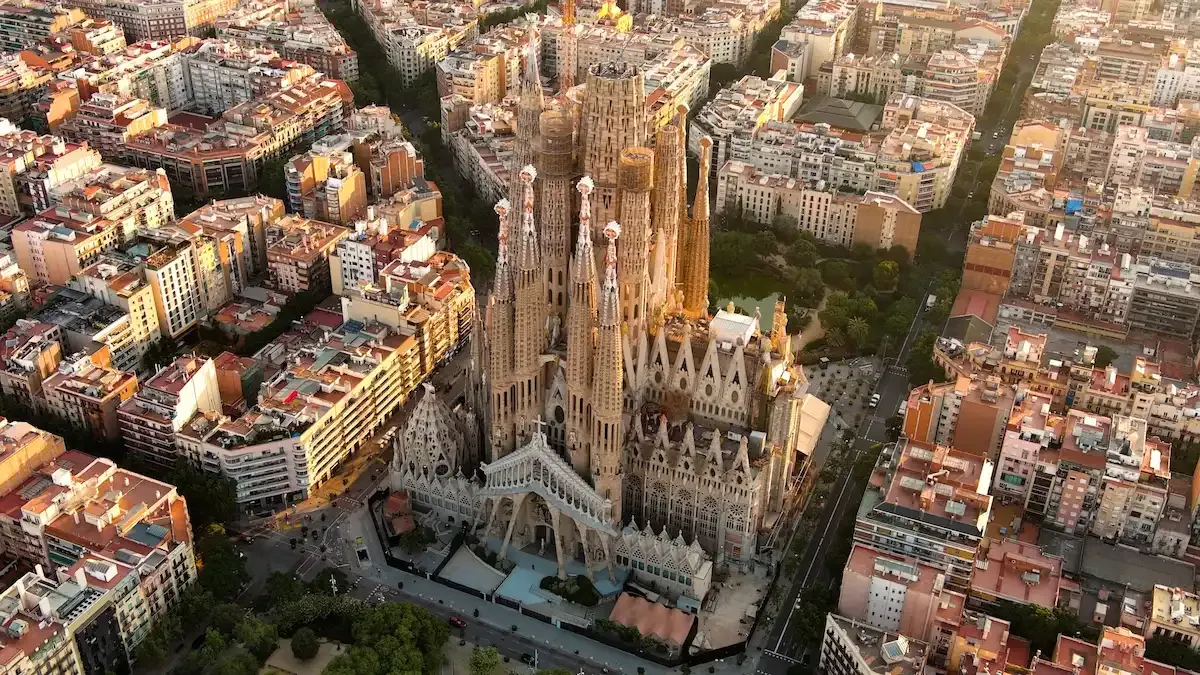
Will buildings on Carrer de Mallorca be demolished for the Glory Facade?
The monumental staircase on Carrer de Mallorca remains Barcelona’s most contentious urban planning dispute, affecting approximately 3,000 residents. In March 2025, the construction board reaffirmed its intent to follow the original design, though negotiations regarding relocation and compensation continue.
Barcelona City Council and residents' associations evaluate alternatives, such as a smaller footprint or an underground entrance, to minimize demolition. However, neither option has gained formal approval. The resolution of this conflict will determine the final street-level appearance and accessibility of the basilica's main entrance.
How does the Glory Facade compare with the Nativity and Passion facades?
Birth, death, and glory. The Sagrada Familia dedicates one facade to each stage, and the artistic treatment changes with the subject matter.
| Feature | Theme |
|---|---|
| Nativity Facade | Birth and joy of Jesus |
| Passion Facade | Suffering and death of Jesus |
| Glory Facade | Celestial glory and resurrection |
| Feature | Orientation |
|---|---|
| Nativity Facade | Northeast (Carrer de la Marina) |
| Passion Facade | Southwest (Carrer de Sardenya) |
| Glory Facade | Southeast (Carrer de Mallorca) |
| Feature | Primary designer |
|---|---|
| Nativity Facade | Antoni Gaudí (built in his lifetime) |
| Passion Facade | Josep Maria Subirachs (sculpture, 1987-2009) |
| Glory Facade | Antoni Gaudi (design only, unfinished) |
| Feature | Artistic style |
|---|---|
| Nativity Facade | Organic, naturalistic, richly ornamented |
| Passion Facade | Angular, geometric, austere |
| Glory Facade | Monumental, symbolic, vertical |
| Feature | Completion status |
|---|---|
| Nativity Facade | Completed (towers finished 1930) |
| Passion Facade | Completed (sculpture program finished 2009) |
| Glory Facade | Under construction |
| Feature | Number of towers |
|---|---|
| Nativity Facade | 4 (Apostles) |
| Passion Facade | 4 (Apostles) |
| Glory Facade | 4 (Apostles) |
| Feature | Visitor access |
|---|---|
| Nativity Facade | Tower elevator and spiral staircase descent available |
| Passion Facade | Tower elevator and spiral staircase descent available |
| Glory Facade | Exterior viewing only during construction |
Main photo: “Glory facade - Sagrada Familia 2011" by Jordiferrer.