
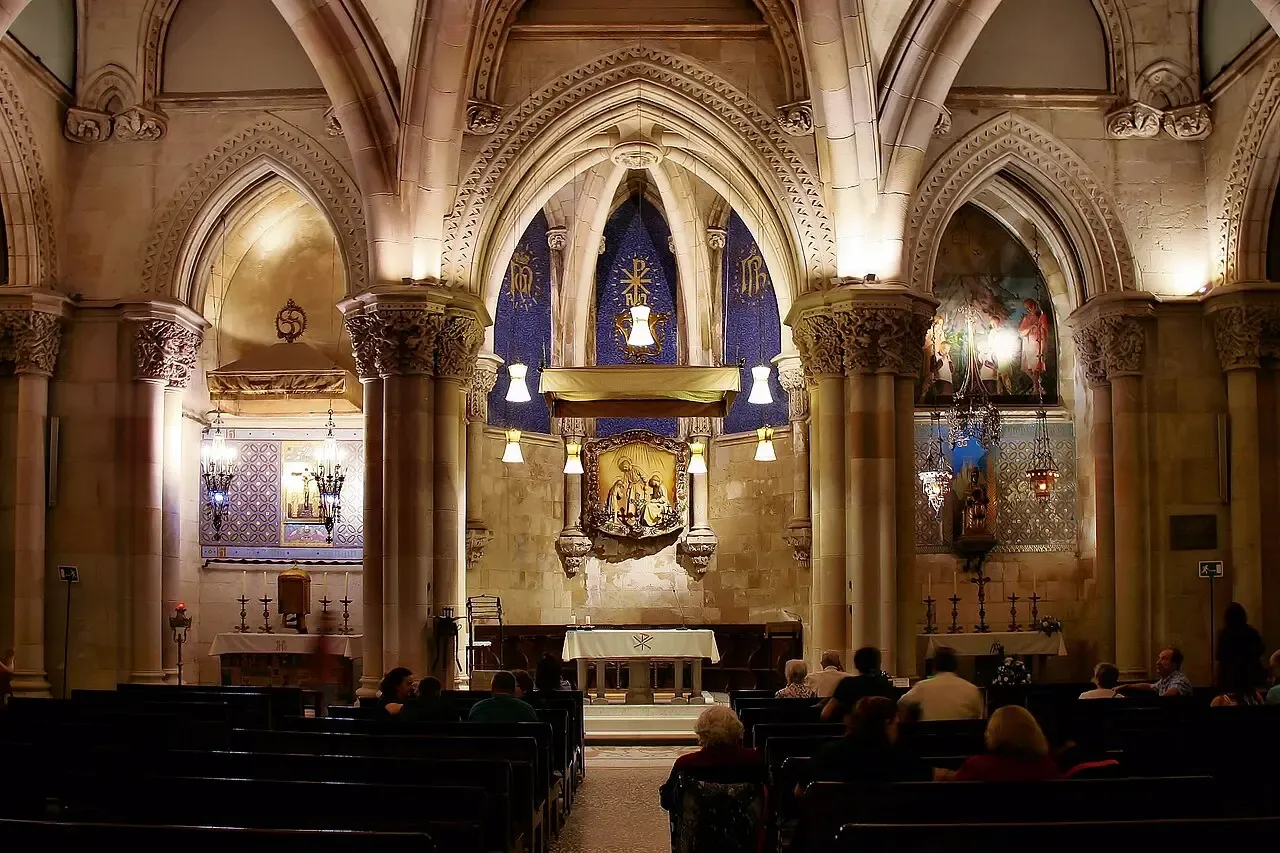
Sagrada Familia crypt
The Crypt of the Sagrada Familia (Cripta de la Sagrada Familia) is the oldest completed space in the basilica, built between 1882 and 1891 below the apse. Seven chapels surround a central altar in a semicircular layout, and the crypt has held religious services since 1885, when the Chapel of Saint Joseph was inaugurated. The space was formally established as a parish in 1930. Antoni Gaudi, the architect who spent 43 years on the project, is buried here in the Chapel of Our Lady of Mount Carmel.
Support when you need it
Customer support to assist you with everything you need from 8:00 to 18:00.
Fast and online booking
Choose the ticket that fits your needs and preferences, and skip the lines by booking here.
Top attraction in Barcelona
Explore the city's most iconic basilica and delve into decades of architectural history.
What is the crypt of the Sagrada Familia?
The crypt sits one level below the main floor of the Basilica de la Sagrada Familia, directly beneath the apse. The space is a working church, not a tomb complex. It was the first part of the basilica to hold regular services, and the only part that has operated without interruption since the 19th century. Seven chapels radiate outward from a central altar, each dedicated to a member of the Holy Family.
Francisco de Paula del Villar, the original architect, designed the crypt in a Neo-Gothic style with ogival windows, buttresses, and pointed arches. When Antoni Gaudi took over the project in 1883, he modified the design but kept the crypt’s foundations and overall layout intact. Villar’s formal Gothic proportions remain in the arches and buttresses, while the vaulted ceiling mosaics and wrought-iron details show Gaudi’s organic approach taking shape.
Some visitors call the Sagrada Familia a cathedral, but it is not one. The Cathedral of the Holy Cross and Saint Eulalia holds that title for the Archdiocese of Barcelona. The Sagrada Familia holds the title of minor basilica, granted during its consecration by Pope Benedict XVI on 7 November 2010.
Main photo: “Cripta de la Sagrada Familia - panoramio” by Panoramio.
History of the crypt
Construction of the Sagrada Familia began with the crypt. On 19 March 1882, Bishop Urquinaona laid the cornerstone on the feast day of Saint Joseph. Francisco de Paula del Villar drew up the initial plans, a Gothic Revival design with conventional buttresses and a pointed bell tower. Villar resigned in March 1883, and Gaudi assumed design responsibility while continuing work on several other projects. He was not appointed Architect Director until 28 March 1884.
Gaudi completed the crypt by 1891. He raised the vault height, redesigned the column capitals, and added a moat around the exterior walls to bring natural light into the underground space. The crypt became the first part of the basilica to hold services and has held them ever since.
On 7 June 1926, a tram struck Gaudi while he walked near the Gran Via de les Corts Catalanes. He died three days later, on 10 June, at age 73. His funeral procession drew thousands through Barcelona, and he was buried in the Chapel of Our Lady of Mount Carmel in the crypt he had helped build four decades earlier. At the time of his death, the basilica was between 15 and 25 percent complete.
A decade later, the Spanish Civil War reached the crypt. In July 1936, anarchists from the FAI set fire to the space and broke into Gaudi’s workshop, destroying many of his original plans and plaster models. Construction stopped until 1939, when Francesc de Paula Quintana took over site management and began reconstruction from surviving materials and published photographs.
In 1982, Pope John Paul II consecrated the crypt chapel during his visit to Barcelona. Two years later, in 1984, UNESCO granted World Heritage Site status to three Gaudi buildings in Barcelona under the collective designation “Works of Antoni Gaudi.” The original inscription did not include the Sagrada Familia. UNESCO extended the listing in 2005 to include two sections of the basilica: the Crypt and the Nativity Facade (Fachada del Nacimiento). Only these two parts carry World Heritage protection, not the entire church.
What to see inside the crypt
The crypt holds the basilica’s oldest artwork, its founder’s grave, and Gaudi’s tomb. Visitors looking down from the apse level of the main church can see the space below, and those attending mass at the Sagrada Familia enter through a separate ground-level door.
The central vault and keystone
The central vault of the crypt holds a sculptural keystone depicting the Annunciation, the angel Gabriel’s announcement to the Virgin Mary. Gaudi designed the vault with radiating ribs that converge on this central point. The mosaic work on the vaulted ceiling combines gold, blue, and earth tones in geometric patterns. Gaudi would develop these motifs further in the basilica’s interior.
Who is buried at the Sagrada Familia?
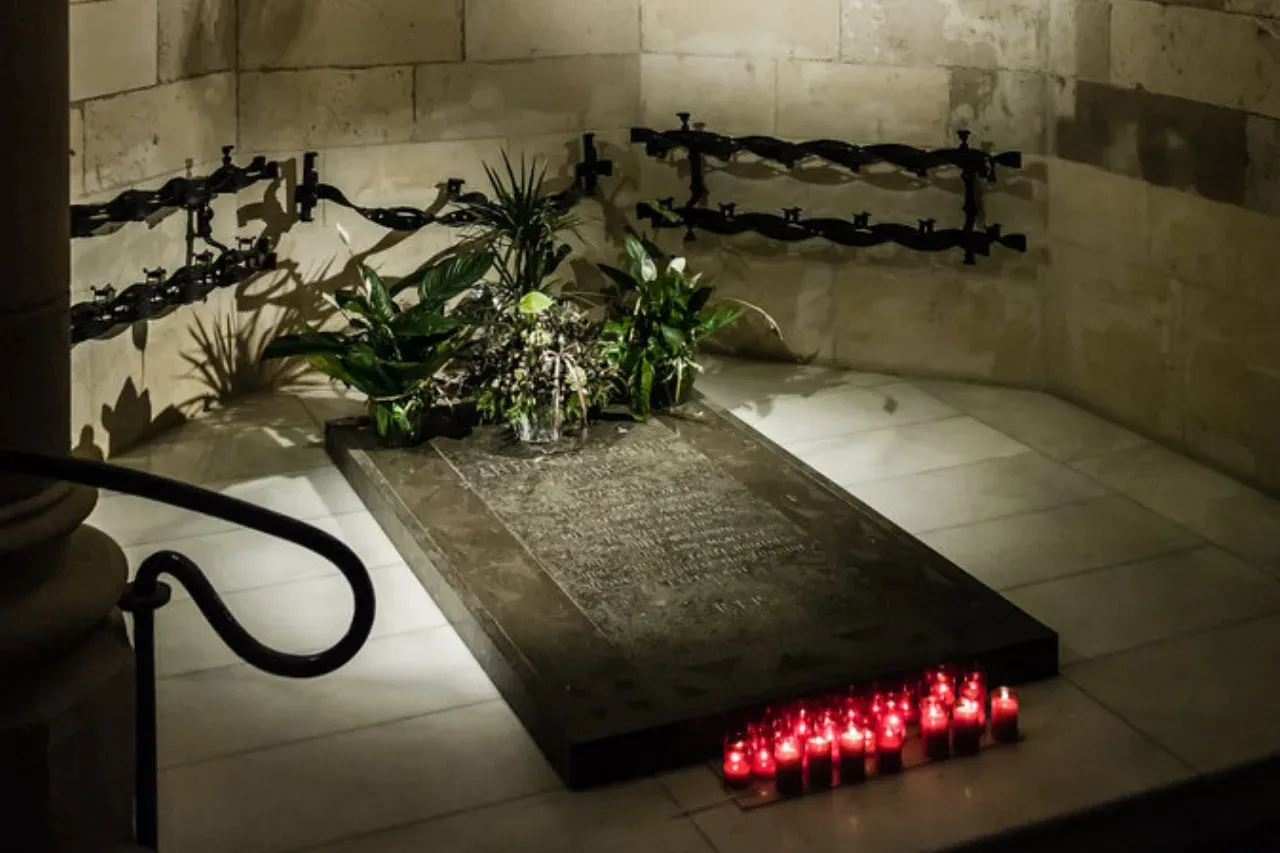
Antoni Gaudi’s tomb sits in the Chapel of Our Lady of Mount Carmel in the crypt. The tombstone carries a Latin inscription, and the grave is visible through an iron grate. Gaudi spent the last 12 years of his life living in a workshop on the construction site, devoted to the basilica. A cause for his beatification and canonization has been open since the year 2000, led by the Archdiocese of Barcelona.
Josep Maria Bocabella, the bookseller who founded the Asociacion Espiritual de Devotos de San Jose (Spiritual Association of Devotees of Saint Joseph), is also buried in the crypt. Bocabella initiated the construction of the Sagrada Familia after a pilgrimage to the Vatican in 1872, envisioning an expiatory temple funded by private donations. Bocabella’s initiative makes the crypt the architectural and spiritual origin of the project.
Visitors who want to see Gaudi’s tomb can view it from the main basilica level above, looking down through a glass panel into the crypt. For a closer view, attend a service in the crypt to reach the chapel level. Sagrada Familia entry tickets for the main basilica also include a view of the crypt from above.
Who is buried at the Sagrada Familia?
Antoni Gaudi’s tomb sits in the Chapel of Our Lady of Mount Carmel in the crypt. The tombstone carries a Latin inscription, and the grave is visible through an iron grate. Gaudi spent the last 12 years of his life living in a workshop on the construction site, devoted to the basilica. A cause for his beatification and canonization has been open since the year 2000, led by the Archdiocese of Barcelona.
Josep Maria Bocabella, the bookseller who founded the Asociacion Espiritual de Devotos de San Jose (Spiritual Association of Devotees of Saint Joseph), is also buried in the crypt. Bocabella initiated the construction of the Sagrada Familia after a pilgrimage to the Vatican in 1872, envisioning an expiatory temple funded by private donations. Bocabella’s initiative makes the crypt the architectural and spiritual origin of the project.
Visitors who want to see Gaudi’s tomb can view it from the main basilica level above, looking down through a glass panel into the crypt. For a closer view, attend a service in the crypt to reach the chapel level. Sagrada Familia entry tickets for the main basilica also include a view of the crypt from above.
Photo: “Sagrada Familia: Andoni Gaudí's tomb in the crypt” by Alessandro Grussu.
Is the crypt open to visitors?
The crypt is visible from inside the basilica with a standard entry ticket. After passing through the main nave and reaching the apse area, visitors can look down into the crypt through openings in the floor and railings. From there, Gaudi’s tomb and the central altar are visible below.
To enter the crypt at ground level, attend mass or a religious service. Entry for worship is free and does not require a Sagrada Familia ticket. The entrance is at street level, separate from the main basilica entrance.
The crypt is below ground, and stairs are the only way down from the basilica level. There is no elevator access for general visitors. Visitors with mobility limitations can see the crypt from above through the basilica floor openings but cannot descend into the space itself.
The basilica’s opening hours are Monday through Saturday from 09:00 to 18:00, and Sunday from 10:30 to 18:00. Mass in the crypt follows a separate schedule that may differ from general visiting hours.
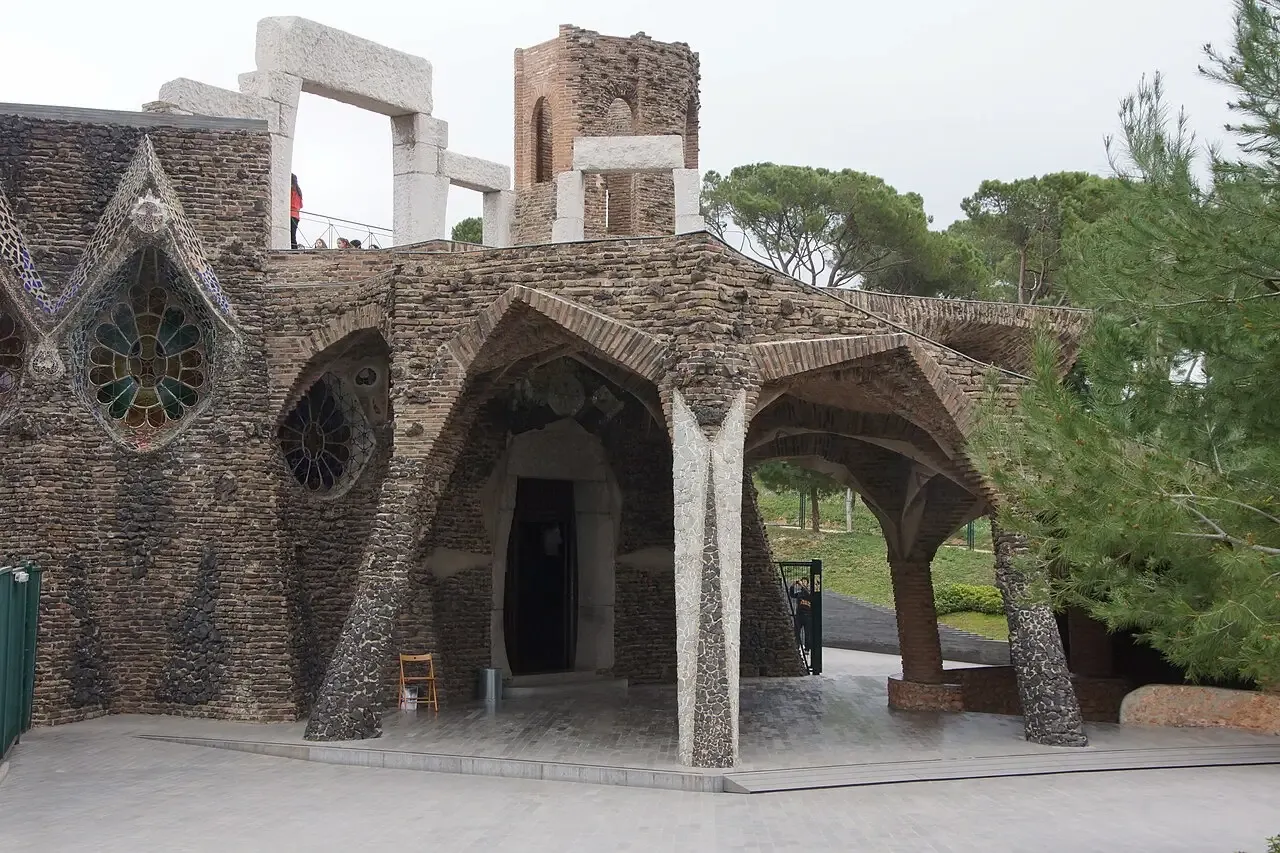
The Sagrada Familia crypt and Colonia Guell
Gaudi designed a second underground church beyond the Sagrada Familia crypt. Between 1898 and 1914, he built the Crypt of the Colonia Güell in Santa Coloma de Cervello, roughly 23 kilometers southwest of Barcelona. This smaller crypt was Gaudi’s architectural laboratory. He tested structural ideas here before applying them at a larger scale to the Sagrada Familia.
At Colonia Guell, Gaudi developed his inverted catenary arch model. He hung chains and weighted bags from the ceiling to determine the ideal curve of arches under compression. The parabolic columns and hyperboloid surfaces that define the Sagrada Familia’s nave originated in experiments at Colonia Guell. The crypt there also uses basalt, brick, and ceramic trencadis, the same material palette Gaudi would carry into the larger basilica.
The Sagrada Familia crypt (1882-1891), the Colonia Guell crypt (1898-1914), and the basilica’s completed nave (consecrated 2010) mark three stages in Gaudi’s shift from Neo-Gothic structure to organic form.
Photo: “Cripta de la Colònia Güell (16907189985)” by Rudolphous.