
Inside the Sagrada Familia
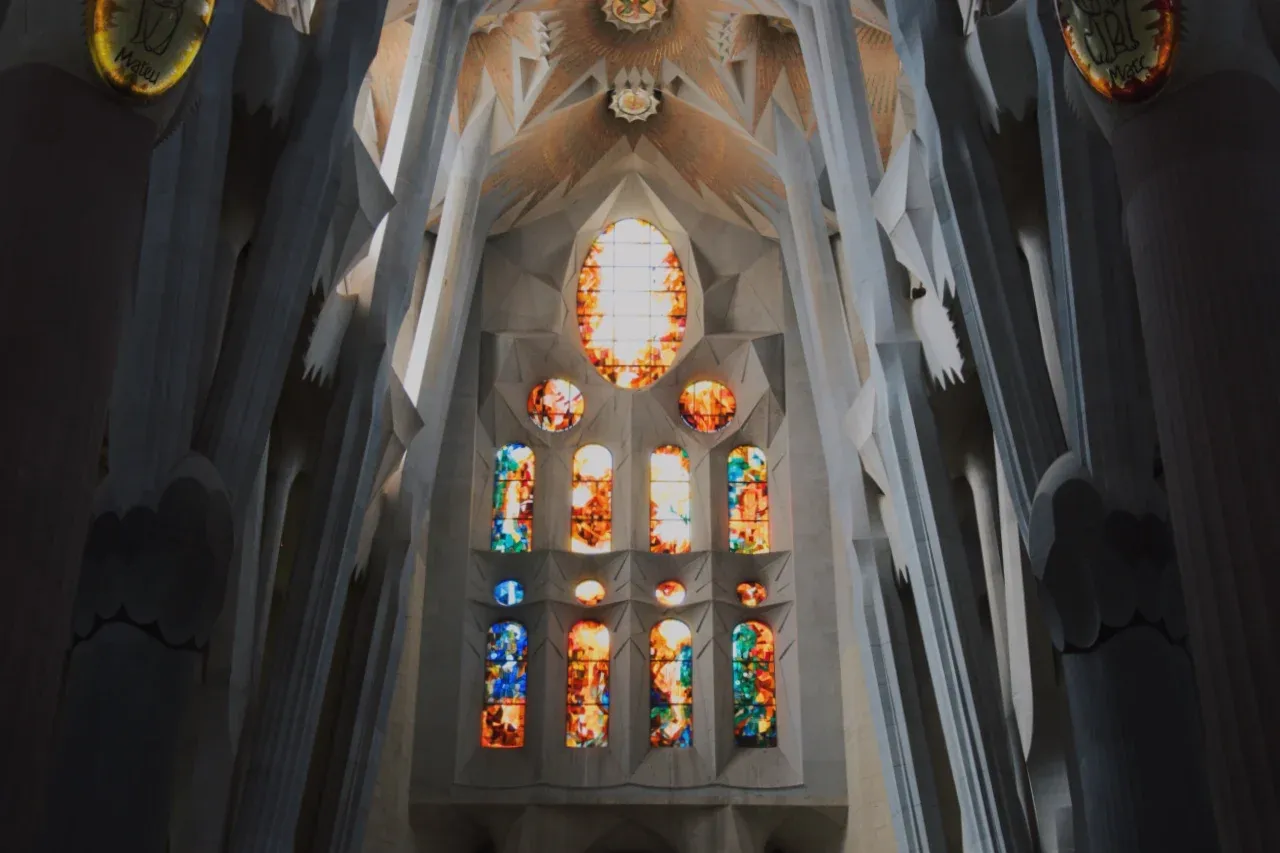
The Sagrada Familia's interior, in Barcelona's Eixample district, replaces flying buttresses with hyperboloid branching columns that hold up 45-meter vaults on their own. Over 8,500 square meters (sq m) of stained glass shifts the nave from warm golden tones in the morning to cool blue-green in the afternoon. Four zones make up the visit: the column-lined nave, the apse with its 7,268-pipe organ, the underground crypt where Antoni Gaudí is buried, and two sets of towers accessible by lift.
Four interior zones, 90 meters of nave, and 45-meter vaults
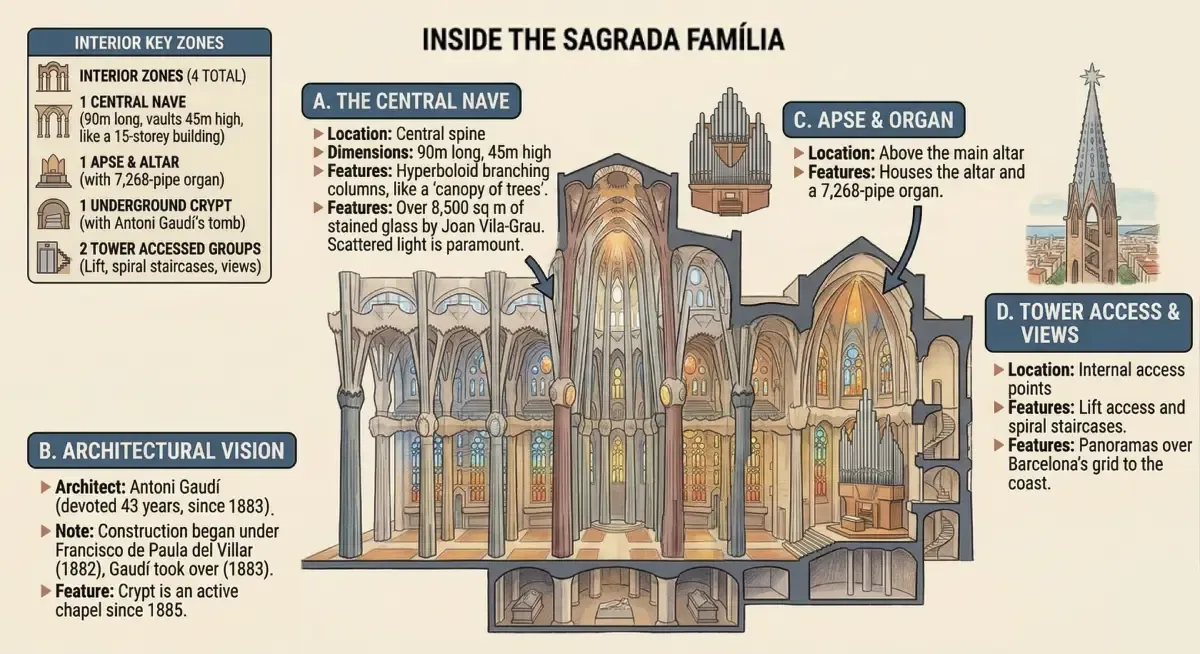
The interior breaks into four zones: a central nave lined with hyperboloid branching columns and over 8,500 sq m of stained glass by Joan Vila-Grau, an apse housing the altar and a 7,268-pipe organ, an underground crypt containing Antoni Gaudí's tomb, and two sets of towers with lift access, spiral staircases, and views across Barcelona's grid to the coast.
Walk through the entrance of the Basílica de la Sagrada Familia and the light hits you before anything else. Sunlight enters through thousands of stained glass panels and scatters across stone columns that branch overhead like a canopy of trees. The nave runs 90 meters long, with central vaults reaching 45 meters, roughly the height of a 15-storey building.
Antoni Gaudí, the Catalan architect who devoted 43 years of his life to the project, began work in 1882. The central Tower of Jesus Christ, still under construction, will reach 172.5 meters and become the tallest church tower in the world. The building holds 18 towers, three monumental facades, and a crypt that has served as an active chapel since 1885.
Construction began in 1882 under architect Francisco de Paula del Villar before Gaudí took over the following year. Our Basílica de la Sagrada Familia page covers the full history from foundation to projected completion.
The forest of columns and how Gaudí made the ceiling hold itself up
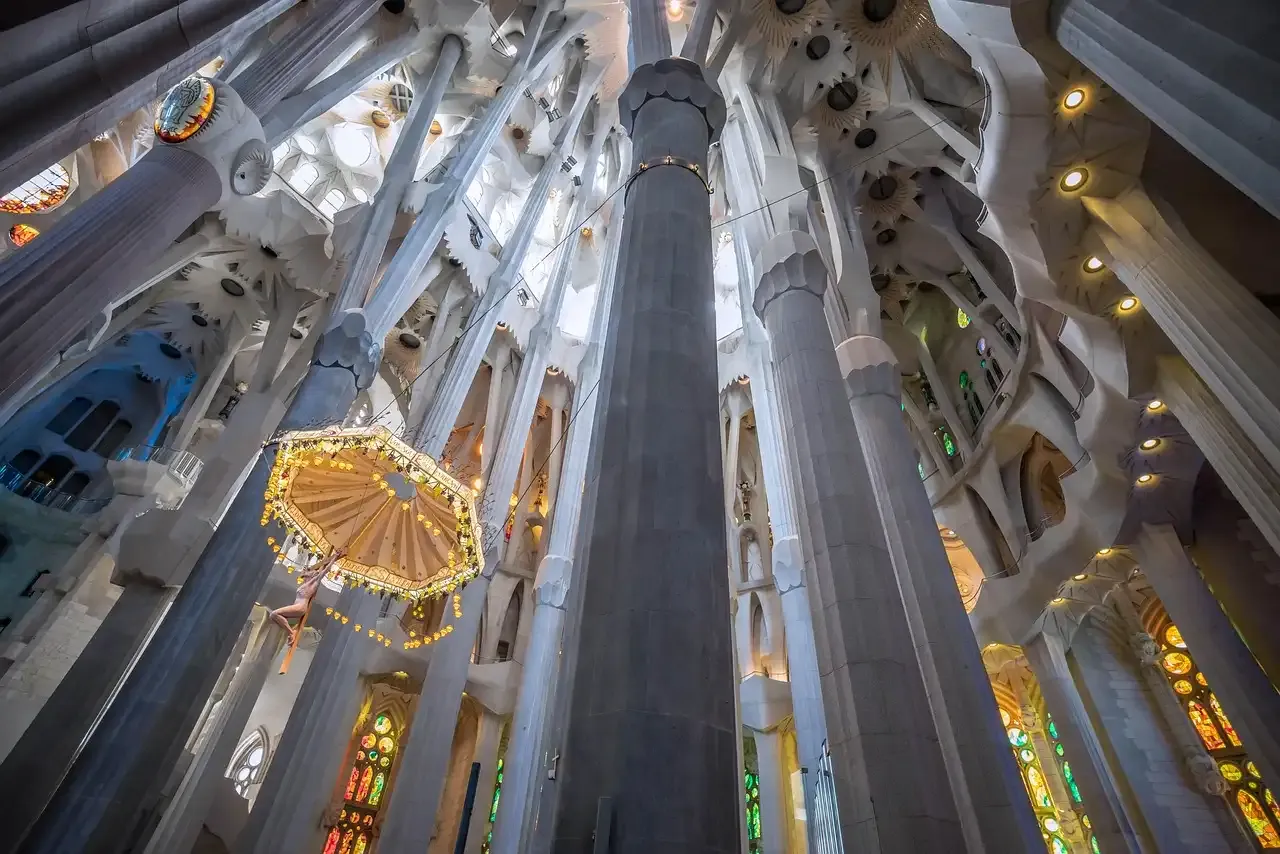
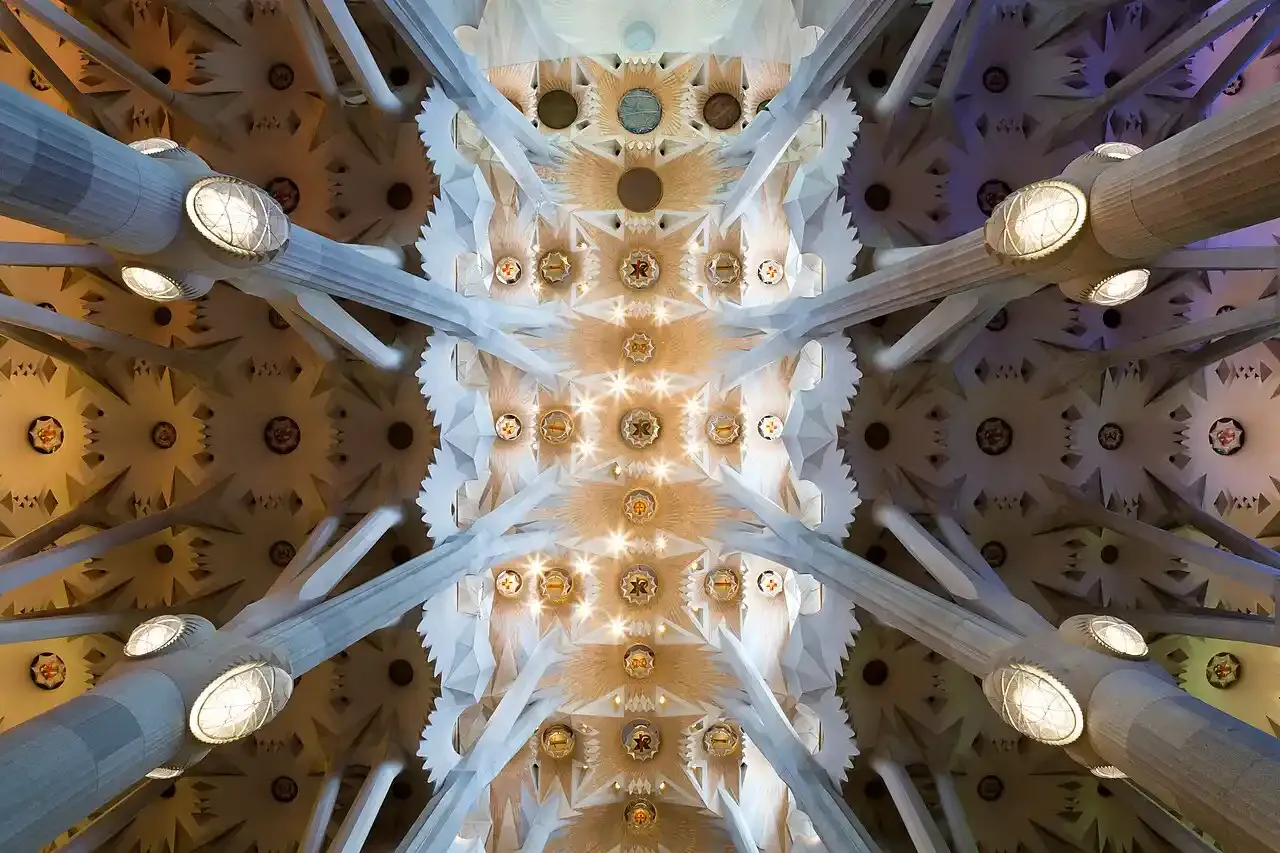
The Sagrada Familia's nave rests on a system of hyperboloid branching columns that distribute the weight of the vaulted ceiling without any flying buttresses. Traditional Gothic cathedrals, such as Notre-Dame or Chartres, rely on external buttress arches to keep their walls from collapsing outward. Gaudí eliminated the need for external supports entirely by designing columns that split and branch at calculated angles, channeling the load downward through the same geometry that trees use to hold up their own canopies.
Branching geometry
Look up from the nave floor and you stand beneath a stone forest. Each column begins as a single trunk near the base, then divides into thinner branches that fan outward to meet the ceiling vaults. Gaudí derived the branching angles from the geometry of tree growth. He studied how trees distribute weight from their crowns down through trunk and root systems, then replicated that logic in stone.
The stained glass and why the time of day changes everything
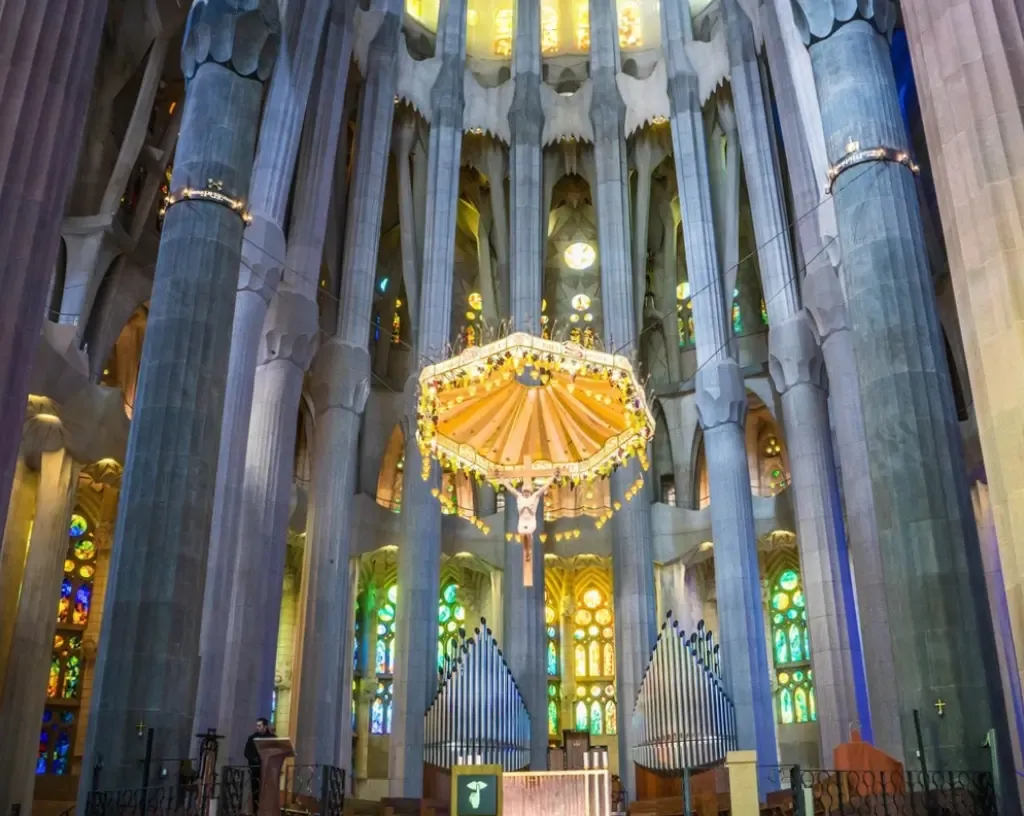
Joan Vila-Grau, the Catalan painter and stained-glass artist, designed over 8,500 sq m of glass panels across the Sagrada Familia's east and west facades. The project began in 1999 and continues today. Colors shift from warm to cool depending on which facade catches the sun. Our stained glass windows page covers each window's symbolism, color palette, and Vila-Grau's design process.
The east windows face the Nativity Facade, which receives direct morning sunlight. Before 11:00, that light passes through amber, gold, and warm red glass, flooding the nave with a golden wash. The west windows face the Passion Facade and catch the afternoon sun. After 15:00, the nave turns cool blue, green, and violet. Enter at 09:00 and again at 16:00 and you will think you are in two different buildings.
| Time of Day | Morning (before 11:00) |
|---|---|
| Which Windows Dominate | East (Nativity Facade) |
| Color Effect | Warm amber-gold tones |
| Best For | Warm, golden interior + smallest crowds |
| Time of Day | Midday (11:00–15:00) |
|---|---|
| Which Windows Dominate | Mixed, both facades lit |
| Color Effect | Neutral, balanced light |
| Best For | Seeing both color palettes simultaneously |
| Time of Day | Afternoon (after 15:00) |
|---|---|
| Which Windows Dominate | West (Passion Facade) |
| Color Effect | Cool blue-green tones |
| Best For | Blue-green atmosphere + strongest photo contrast |
Your preferred light effect decides the best time slot. Morning visits before 11:00 combine the warm golden east-window light with the smallest crowds of the day. Monday through Saturday, the basilica opens at 09:00. Afternoon visits after 15:00 deliver the cool blue atmosphere that produces the strongest contrast in photographs. Avoid Sunday at 13:00, the busiest slot. Tuesday, Wednesday, and Thursday are the least crowded days.
The three facades and what to look for from the inside
Three monumental facades face three directions and tell three chapters of Christ's story. From inside the nave, each entrance portal frames a different sculptural style and a different quality of light.
| Facade | Nativity |
|---|---|
| Orientation | East |
| Sculptor / Period | Gaudí / 1892–1930 |
| Style | Naturalistic, organic forms sculpted from life |
| Don't Miss | Cypress tree topped with a white dove, symbol of the Holy Spirit |
| Facade | Passion |
|---|---|
| Orientation | West |
| Sculptor / Period | Subirachs / 1990 |
| Style | Angular, stark, stripped of ornament |
| Don't Miss | Magic square: 16 numbers that sum to 33 |
| Facade | Glory |
|---|---|
| Orientation | South |
| Sculptor / Period | Under construction |
| Style | Not yet fully realized |
| Don't Miss | Will be the largest and main entrance when complete |
The Nativity Facade (Façana del Naixement), the only facade Gaudí saw near-complete, faces east and receives morning light. Gaudí used live models, local workers, casts of corpses, and animals, to achieve the naturalistic sculptures that cover the entrance. The detail is dense: turtles support the columns, birds nest in the stonework, and an entire nativity scene unfolds across the portal.
The Passion Facade (Façana de la Passió), designed by Josep Maria Subirachs, the Catalan sculptor, opposes the Nativity in every way. Subirachs stripped the figures down to angular, skeletal forms. The central scene depicts the Kiss of Judas. Look for the S-shaped curve behind Judas, a compositional detail Subirachs embedded as a reference to the serpent of betrayal. On the left side of the facade, a 4×4 magic square contains 16 numbers that sum to 33, Christ's age at crucifixion.
The Glory Facade (Façana de la Glòria), the largest and still-unfinished main entrance, faces south. When complete, the Glory Facade will become the primary entrance to the basilica and close the theological narrative: death, judgment, glory.
From the center of the nave, all four zones read as a single space: columns rising to the vaults, stained glass filtering light from both facades, and the entrance portals framing the city beyond.
The towers, what you see from inside and whether to go up
The towers, what you see from inside and whether to go up
Two sets of towers are open to visitors: the Nativity towers on the northeast side and the Passion towers on the southwest. A lift takes you up; a narrow spiral staircase winds you back down (no lift for the descent). From the tower bridge that connects the two spires on each side, you look outward through lattice stone openings to Barcelona's Eixample grid, the Mediterranean coast, and Montjuïc. Turn inward and look straight down through the lattice into the nave: the column canopy spreads below you, and the stained glass patterns become readable at a scale the ground floor cannot offer.
The Nativity towers offer the best exterior and city views. The Passion towers position you for stronger interior light: the afternoon sun through the west-facing stained glass casts blue-green reflections on the tower stone. The spiral staircases are tight, counter-clockwise descents with worn stone steps and narrow window slits that frame the city in thin vertical strips.
The crypt and Gaudí's tomb, the quietest part of the visit
The crypt beneath the Sagrada Familia's apse is the oldest completed part of the basilica, built between 1882 and 1891, and it has served as an active chapel since 1885. Access is included in the standard ticket. The entrance is a staircase near the apse, easy to miss if you are not looking for it.
Underground, you step into a different building. The crypt is small, low-ceilinged, and quiet. Candles and dim lighting replace the stained glass glow. Gaudí is buried here beneath a simple stone slab, often marked with fresh flowers. His beatification cause, the formal process toward sainthood, remains ongoing within the Catholic Church. The Bocabella family, who founded the Sagrada Familia project in 1882, is also interred in the crypt.
The chapel holds regular services, and you may encounter a mass in progress. Expect silence and candlelight instead of the crowd noise on the nave floor above.
Gaudí's symbolism and what to look for before you miss it
Six specific details inside the Sagrada Familia reward visitors who know where to look:
-
Column stone progression. Stand in the central nave and look at the column bases. Four stone types grade from dark outer columns to golden inner ones, following the structural logic detailed in the column section above. The color shift is visible from the center of the nave.
-
The pipe organs. Look up at the north transept to find the main organ, which contains 7,268 pipes. The Sagrada Familia houses 4 organs in total, including a choir organ with 1,492 pipes. On concert days and during certain services, the organs resonate through the stone nave. Gaudí designed the acoustics to carry that sound.
-
Ceiling bosses. At every intersection where the vaulted ceiling ribs meet, polychrome ceramic spheres sit at the junction points. Spot them from the center of the nave by looking straight up. Each one is finished in bright green, gold, or red against the pale stone.
-
The Kiss of Judas S-curve. On the Passion Facade, look behind the central Kiss of Judas sculpture for an S-shaped curve. Subirachs embedded it as a serpent reference, described in the facades section above.
-
Salamanders and turtles on the apse. Walk around the exterior of the apse (the east end of the basilica, behind the altar). Salamanders and lizards crawl across the stone drainage spouts. Two large turtles support the base columns of the Nativity Facade: a sea turtle on the Mediterranean side, a land tortoise on the mountain side. Both represent the unchanging nature of creation.
-
Fruit-topped pinnacles. The towers of the Nativity Facade are crowned with baskets of ceramic fruit: grapes, oranges, wheat, and other harvest symbols. Gaudí chose fruit over conventional crosses or gargoyles to represent the abundance of nature and the Eucharist. The polychrome ceramic mosaic finishes are most visible in direct sunlight.
Practical tips to get the most from your inside visit
The Sagrada Familia opens Monday through Saturday at 09:00 and Sunday at 10:30, closing at 18:00 every day.
- Arrive at opening on a weekday. The basilica is least crowded on Tuesday, Wednesday, and Thursday. Arriving at 09:00 combines the smallest crowds with morning stained glass light. The golden east-window effect described in the stained glass section peaks before 11:00.
- Book tickets online and in advance. Time slots are fixed and sell out fast, especially for morning entry.
- Decide on towers before you book. You ride a lift up and descend by spiral staircase; there is no lift down. The tower interior and views are covered in the towers section above. Book the tower add-on at the same time as your main ticket; separate tower-only bookings are not available.
- Budget 1.5 to 2.5 hours. The nave, apse, and crypt take about 1 hour 30 minutes at a comfortable pace. Add 45 minutes if you take the tower lift. A thorough self-guided visit with photography stops runs about 2 hours 30 minutes.
- Skip Sunday at 13:00. That slot registers the highest visitor density. If Sunday is your only option, arrive when doors open at 10:30.
- Use the audio guide, not just your eyes. The app-based audio guide is included in every ticket and explains the symbolism, architecture, and history at each point. Without the guide, details like the column stone progression and the ceiling bosses are easy to walk past without understanding.
Is it worth going inside the Sagrada Familia? Yes. Gaudí's hyperboloid branching column system exists in no other building on Earth; this is the only place to see it. The stained glass creates a light effect that changes by the hour, so a morning visit and an afternoon visit look different. And the Sagrada Familia is still under construction (projected completion: 2033), so the interior evolves year to year. What you see today will not match what visitors see in five years.
Book your tickets in advance. Morning time slots sell out fastest, and those morning slots deliver the best light with the smallest crowds.